Posted: 2026-03-05
🔗 The Coercion Handbook: Machinery of Control
🔗 (Living Document - Work In Progress)
Roughly 2/5ths complete. Conceptually 80ish% done.
Dedicated to truth and justice.
🔗 Introduction
What is the minimal repeatable structure that reliably produces isolation, reputational harm, and destabilisation – even when no single act is overtly abusive?
A small number of people I know of (none of whom were ex-partners of mine) have just used this structure over and over again, and each has a giant trail of wreckage to suit. From the outside it looks like a whole lot of nothing, and that's precisely what makes this form of abuse so dangerous and traumatic: from the inside it looks like "my life was somehow silently dismantled in the background."
This is a very real, very serious form of abuse whose central characteristic is that the people around them can't see it, making it easy to frame the target as "dramatic" or "unstable", and their isolation as "their own fault". It is almost entirely made of choices to which individual free consent is given.
This form of coercive control involves rearranging a person's social environment so that the individually voluntary actions of the people around the victim turn into an enforcement mechanism. This form of abuse is a load-bearing component of many forms of domestic violence proper.
This work is a composite analysis of recurring coercive dynamics, drawn from many sources and patterns. It is not an allegation against any individual.
🔗 Preface
This has been an epic project. It is intended to be anti-fiction.
It’s involved following numerous trails of wreckage across relationships, communities, and institutions spanning years, examining the social dynamics that reliably leave this kind of damage behind, and pulling the common threads from each. The number of people and systems that systematically use these tactics is quite small, but there are a very large number of people affected by them.
From those informal data points, I was able to compile a repeatable playbook that many operators follow, which may be useful in recognising these patterns in the future. These games revolve around plausible deniability, and the more people who are aware of their mechanics, the less effective they become. When the targets compare notes, it all falls apart very quickly.
There reached a point where each new tactic started simply becoming more mechanisms to document. This is when they stopped being scary and confusing, and started becoming evidence.
A large number of people have privately spoken up and some of their testimony has been shared anonymously. The silencing, isolating and shaming effects of this form of abuse mean they are best transmitted this way. Many acknowledged that they had something to share, but that they weren’t in the right place in their recovery journey to be ready.
More than half of the targets I spoke to were not able to give testimony on account of the emotional effects of what was done to them, even years later. Their silence is not neutral.
None of the lived experience entries are my own.
🔗 Warning
We'll be discussing very real and serious abuse behaviours with very real and serious consequences for the target. We will be examining these behaviours with a kind of forensic empathy which could very easily disturb many people.
After 34 years of not being targeted, I've now made it through this process a half dozen times in 3 years. It's fucked up to go through even once. Going through it repeatedly in a short period was a psychological gauntlet, but it does mean I know the mechanisms back to front by now.
The deniable nature of this form of abuse means that targets rarely get recognition: when it works, they are painted as the problem. As a result, these topics often remain sensitive many years later.
The most shocking part of this project has been discovering how many unrelated people reported nearly identical experiences, usually tracing back to the same few individuals.
When engaging with these topics, please stay connected to your support network and practice self care.
🔗 Terminology
The terminology we'll be using is that the operator socially attacks the target by manipulating mutuals. There are also usually bystanders who see parts, but not all, of this process.
🔗 Scope
We are specifically talking about situations where there is factually one party who is acting in good faith, and another party who is not.
These cases are particularly important to understand, because the operators' playbook revolves around making it look complicated and symmetrical when it's factually not. We need to learn to pull these situations apart and show them for what they are when you look past the deliberate water-muddying.
That's not to say that such cases are the norm, and you shouldn't assume they are from the focus we're giving them. But they're especially revealing, and that is critical to understanding the structure of this topic.
I am, quite frankly, done pretending the polite fudging of these situations is neutral.
Some situations are complicated human messes with no moral architecture. Some are absolutely not, but are maliciously dressed up as them.
The techniques are made of fairly normal actions: for example, hosting a social event without someone you have a problem with is not itself presence manipulation. It's when people use them together as a pattern of control that it becomes abuse. We are looking at abuse that can be passed off as a collection of normal everyday actions. That's what makes it so sinister.
There is no one flag or criteria for when these actions become abusive: they have to be examined holistically to be understood, which is a core component of how they often work so well.
🔗 Disclaimer
Each operator's methodology is somewhat different. There are absolutely common threads to each, but don't take any of this as a prescriptive identification manual. Use common sense and caution when figuring this out. Coercive control is a diverse field and you cannot distill it into a specific set of red flags – these are just the common threads from the experiences of myself and other targets. It is sometimes possible for a person to both coerce one person and be coerced by another, and those situations can be fractals of complexity. Operators will take advantage of this possibility as part of the control process via DARVO (Deny, Attack, Reverse Victim and Offender).
When you see this, it won't look exactly like I'm describing. Thinking critically about what you see is important.
🔗 Important Note
Abuse does not have a gender, and gender-exclusive claims further marginalise people who are already under-represented in survivors' movements. This style of abuse can be weaponised by any gender identity, and arguing about proportions doesn't help us understand it. Focusing on mechanisms instead of identity gives us a more accurate and nuanced picture of coercive dynamics.
🔗 Introduction to Coercive Systems
🔗 Fundamentals
We will be taking a network synthesis approach to coercion. There will be a lot of new terminology that doesn't exactly align with the existing coercive control research, but most of the ideas will be familiar to anyone who engages with it.
The benefit of this approach is that it doesn't rely on pathology or relational descriptors; because we are looking instead at mechanisms across a network, we can more precisely describe the process of coercion across organisations, institutions and social groups rather than a particular kind of an abusive relationship.
🔗 Skill
The coercive techniques described here are specifically skills, not pieces of knowledge. You can read 200 books about bicycles and still be utterly unable to ride one.
🔗 Summary
This is the core set of processes I found coercive operators to use:
- Capture the narrative via access control:
- Co-opt normal responses into evidence for the narrative:
- Use plausible deniability to avoid the appearance of overt action:
- Recruit the people around the target without them realising:
- Invert the narrative when challenged:
- Reinforce feedback loops:
This section is not finished yet.
🔗 The Prime Frustration
It is difficult to build a framework for abuse which is plausibly deniable and self-sealing without facing the risk of the framework itself becoming self-sealing.
The trouble is: when the abuse is made of a large number of fragments which are innocuous on their own, and no one person has a complete picture of them, it is hard to prove either way. That's the whole point.
The four central methods we can use to identify this abuse despite this are:
- Longitudinal study: Look at large-scale patterns over time and context to identify repeated events
- Examining access: Look at who does/doesn't have access to which environments and why
- Examining the flow of information: Look at where claims are actually originating from, who is unable to respond to them, and who is avoiding fact checking
- Identifying costly ethical actions: Who did the right thing, even when it cost them and they gained nothing?
By following the use of time, space and information we can tease out the patterns.
These methods are subtle: the patterns are not small, but they are usually not obvious.
🔗 Falsifiable Predictions
If a story about someone is true, what else should we expect to observe?
Does their behaviour across time and contexts actually fit the claim? Can the story generate specific predictions that might turn out to be wrong? If not, it may be a constructed narrative rather than an explanation.
The most powerful way to test this is by pre-committing to a prediction – that way you can't twist it as much afterwards.
Not finished yet.
🔗 Getting It Right
Understanding what is/isn't coercion, longitudinal evidence, and when you are actually in the wrong. Understanding repeated coercive structures across a small number of targets.
Not finished yet.
🔗 Spotting It: Practice Makes Perfect
🔗 Are Operators Acting Consciously?
🔗 Patterns Are Not People
Someone may well fulfil every aspect of a particular role in one of those diagrams. That is not a license to be reductive: obviously they are still their own person with their own internal world, regardless of which roles they play in coercive systems.
🔗 Presence Manipulation
"The only secret of magic is that I’m willing to work harder on it than you think it’s worth."
~Penn Jillette
Coercive social control is often produced without any one overt act – by controlling who is present, who has access, who speaks privately, and which account becomes easiest for the group to maintain.
A lot of what operators do works because normal bystanders don't want to believe anyone would put in that much sustained effort. The process sounds too fussy, too strategic, too embarrassing, too labor-intensive. There is no stroke of genius in here. The trick is only hard to see because most people underestimate how much boring, repetitive, petty work someone will do to control a social environment.
What sort of person would do this? Someone completely and unhealthily obsessed with controlling narratives.
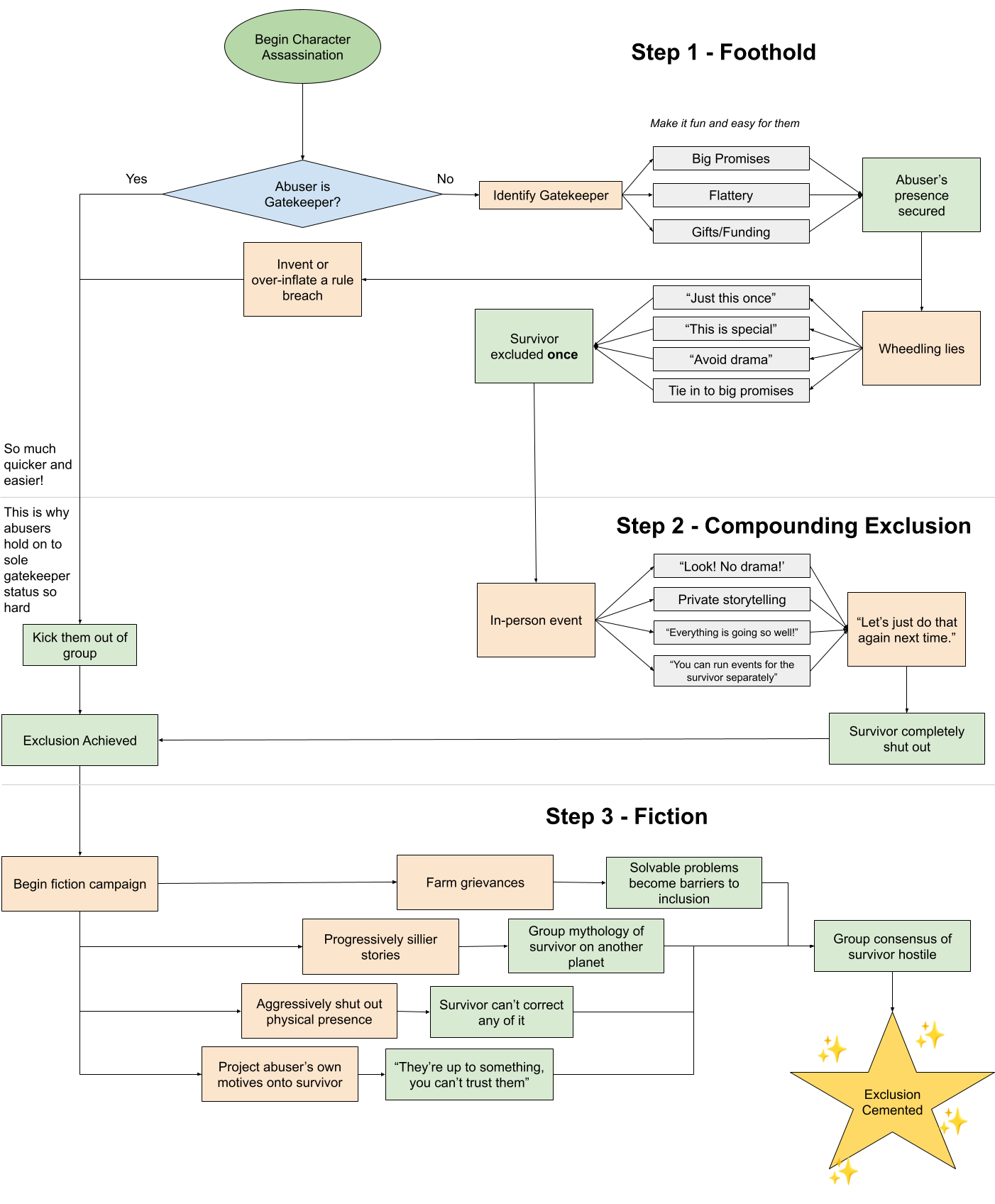
This is by far NOT the only workflow possible, but it should give you a pretty good idea as to the character of this method.
If you're looking at that diagram and thinking, wow, that's a lot of work to isolate someone: yeah. Operators are very invested in control.
Before the operator can make the target evil, they have to render them one-dimensional. Before they can render them one-dimensional, they need distance between the target and the mutuals.
Let's break it down.
🔗 Basic Methodology
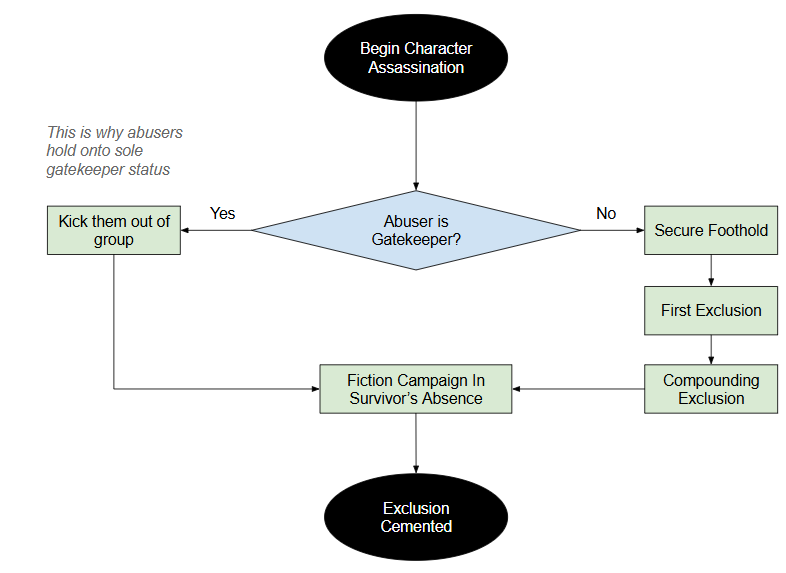
People often default to the version of events that takes the least effort to maintain – the closer you physically are to someone, the more detailed and realistic your view of them. Being physically present is a powerful emotional hook which makes a person's statements easier to trust in greater detail, and the more distance we have from someone, the easier it is to reduce their reality to simple caricatures of what is actually known of them. It's not simply about emotional resonance, but cognitive load – trusting the in-group in front of you.
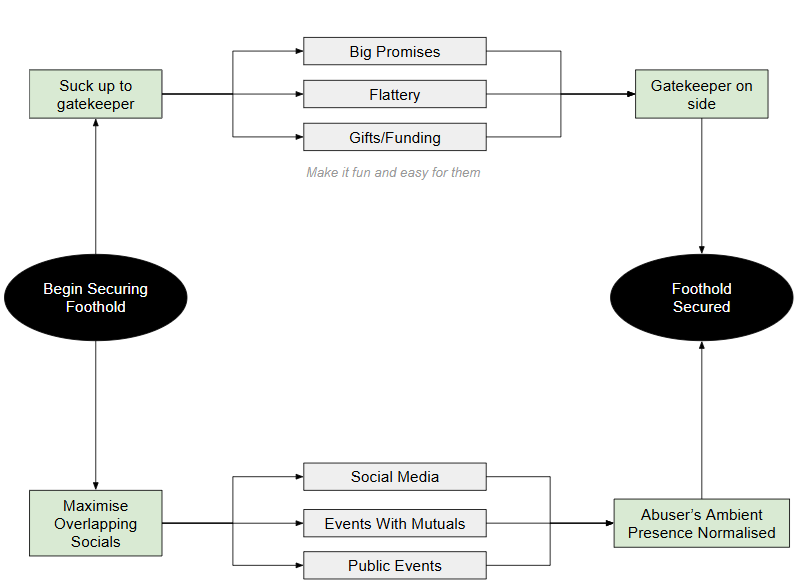
This is why the operator's number one priority is: be more socially present than the target.
The goal is not to win conflicts, but to occupy the social stage.
🔗 Hierarchy of Presence
- Alone in-person is worth more than group in-person.
- In-person is worth more than phone.
- Phone is worth more than text.
- Text is worth more than absent.
Presence superiority is the foundation on which most other coercive tactics rest.
Physical presence in a group implies acceptance of that group.
The operator needs to be as high up this hierarchy as possible, and the target as low as possible. This is an extremely high priority for them, because most of their playbook depends on a higher level of presence. They do not have to be more liked, just more present.
Climbing this ladder is a normal and healthy part of socialisation; what makes it abusive is weaponising it to spread disinformation.
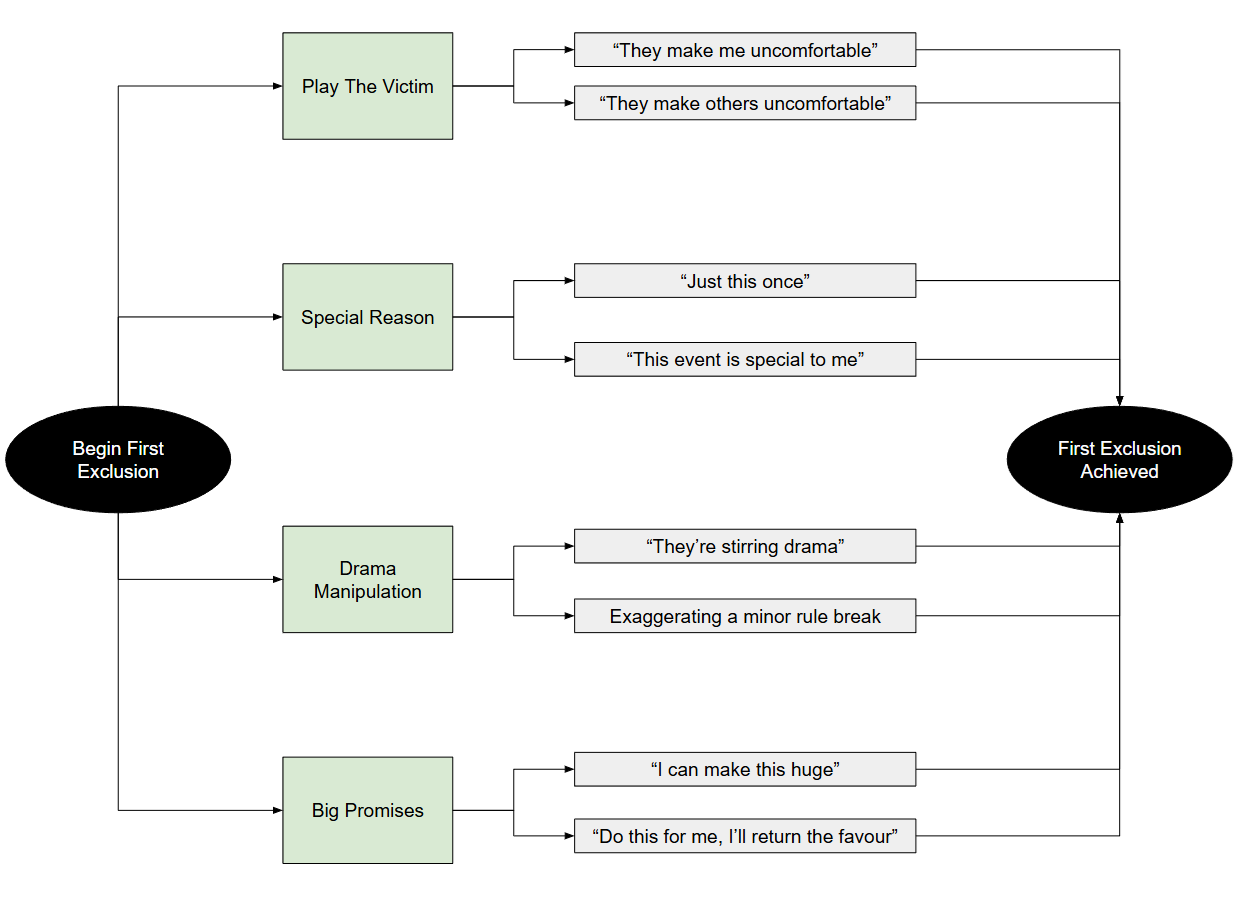
The actual tall tales the operator tells do not necessarily have to be done in-person; they just need to see the mutuals in-person a lot more than the target. The operator does not in fact even have to be liked for this to work – they just need to be present.
As the operator pushes a person further and further out, it becomes easier and easier to control the narrative and replace it with fiction. Conflict and grievances with others in the group – some of which may be legitimate – can effectively become permanent and irreparable. Things which may have been minor or resolvable can be used as a barrier to reentry for someone who is excluded.
When this process works, the person's former friends won't think they've been manipulated. They'll just think the target is a horrible person and will readily rattle off a list of reasons that have not actually been checked against reality at any point.
🔗 Understanding Gatekeepers
Gatekeepers are the people who have control over events and venues. They're the people who decide who gets invited to things, who is banned, and who is welcome where.
Critically: these are the people who must make compromises and build bridges. They're the ones who smooth things over in a diverse group which sometimes experiences conflict.
🔗 Coercive Gatekeepers
The ideal position for the operator is one where they are the only gatekeeper to a social group: where they have the ability to summarily remove a person from a group and there is absolutely no process for challenging this. Everyone must follow their direction, or they will be socially isolated.
Operators who achieve this successfully will often integrate these structures into their personality and never, ever let go of the system concept, even when they are now a "has-been" and those glory days are long past.
🔗 The Playbook
When the operator is not the gatekeeper, this becomes a game of inches.
The gatekeeper is the number one priority. The operator will obsessively push for any possible exclusion of the target, no matter how trivial. Operators end up sounding "more credible" simply because they've spoken more, spoken first, and spoken in-person.
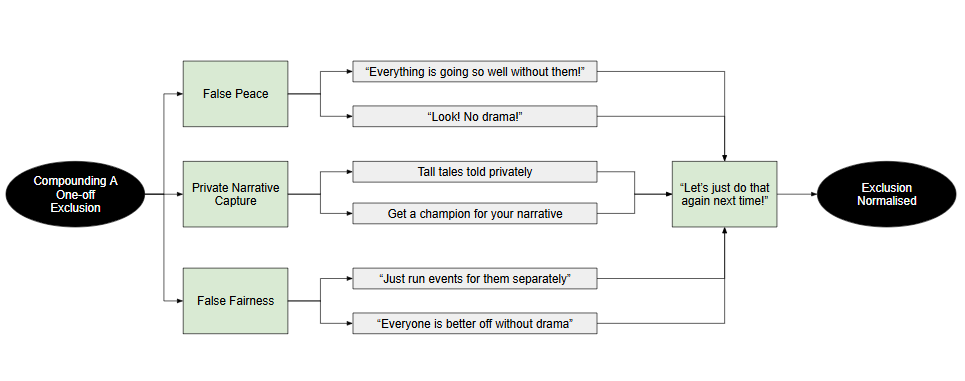
Every time the operator gets the target excluded from an in-person event – regardless of how or why[1] – it is a win which will compound. Wheedling lies add up: they'll argue that there's a special reason the operator needs to be present this particular time but we can't be having the drama from the target being there too. Expect to hear a lot of "just for this" and "just this once" (cowardice by installment plan) because every time the operator does it, the next time gets easier – pull this off enough times and it becomes a norm. Over time, people assume that this norm is justified.
"Look! Drama-free without the target!" says the source of drama. Shrug, okay, I guess we do it again next time. Path of least resistance. In the event that the target actually gets invited to something, the operator will move Heaven and Earth to ensure that there is drama projected onto them – even if they did absolutely nothing wrong at all.
This stage often involves a lot of, quite frankly, whining to gatekeepers who eventually give them what they want in the hope that they'll shut up, mistaking silence for peace. This whining is petulant and comical at first, but it only has to work once.
Operators will play this gambit over and over again, and it often doesn't take much digging to find an incredibly consistent repeated pattern. They will consistently use anything they can to exclude their victims from a social setting, then pry at the crack until they're the only one telling the story about the target. As long as nobody spots the repetition, it'll consistently work.
[1] Current record for silliest real-world excuse to do this: "the body language of you and your girlfriend is [future tense] going to be weird and it will make everyone uncomfortable." The person knew her too, but hadn't seen us together yet. This whole thing is designed to completely bypass critical thinking and it would be hilarious if the consequences weren't so serious.
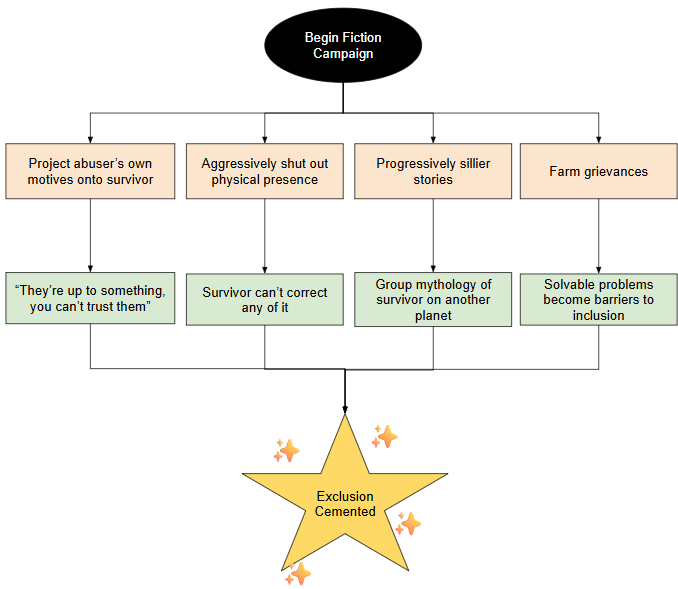
🔗 Lies on Lies on Lies
"Every lie we tell incurs a debt to the truth. Sooner or later that debt is paid."
~ Chernobyl (2019)
Truth is enduring. You only need to say it once, and it's always sitting there in the background.
Lies require upkeep: the interest on lies must either be paid with more lies, or with a collapse of the system. This is why the liar needs to control presence: being present reduces the "interest rate".
This is a critical factor of why presence superiority is so critical: a small amount of credible truth will cause the debt to fall due. To control the narrative, the operator needs to feed mutuals a steady stream of lies about lies, and hope that they give up caring about minutiae (forgive the debt) before the whole thing collapses.
The notion that the mutual has catastrophically fucked up is often disturbing, and they will usually seek an emotionally easier way of understanding the world from the operator.
🔗 Some Small Comfort
A former operator I spoke to was unequivocal: "the lie always falls apart in the end."
I don't know that I believe this to be a universal truth, but it does speak to the fact that maintaining a lie does require endless upkeep, and even modest changes to the social graph's arrangement can make that upkeep nearly impossible.
🔗 Speaking to Mutuals and Bystanders
Ask yourself this:
Who has clustered around the target?
Is it people who have been through this before?
Have you spoken to any of them lately?
If you think they have a "drama" problem, is that actually rooted in anything they've actually done, or is it just the general "vibe"?
Is one person maybe contributing more than their fair share of the "vibe"...?
Was there never actually a problem other than something the operator made up afterwards...?
Have you actually seen the "drama" in person firsthand, or is it actually just what you've heard?
If the target and the operator were at the same event, and it all seemed fine while they were there, did the operator try to retroactively generate conflict? Was the material reality just that they ignored each other, then one party stamped their foot afterwards?
Are you being totally honest with yourself?
Targets can often pick one another, and they will never be able to ignore it when they see it.
Is someone trying to form an artificially strong connection with a gatekeeper?
Are they trying to get that person banned or uninvited from events?
If you do a little digging, will you find out that this is something they do often? That they have a history of doing?
Have you spoken to the other people who have gone through this?
Is this a pattern?
🔗 The Target Is Actually Still A Person
I've seen mutuals be surprised when they meet a target in person for the first time in months or years while this dance is going on: "you're... fine?! I have... no issues talking to you...?"
Desocialisation from abuse is absolutely no joke, but the real-world results are consistently that the mutual is actually quite flabbergasted that the target is not just a continuous stream of drama and meltdowns. When the mutual's physical exposure to the target was entirely second-hand and synthetic, seeing reality up close creates a giant cognitive dissonance.
The reason for this is that since they have been physically absent for a long time, the narrative of their character has been overwhelmingly replaced by the operator's mythology. "Who did I actually hear that from...?" is usually conspicuously missing from the mutual's thought process when only one narrative is actually being presented fully. All in-person speech of the target is about drama, because they're absent and other people can speak on their behalf.
If the operator catches wind that a mutual has realised that the target is in fact still human, they will most likely escalate fast and hard with misinformation.
Gradual, systematic manipulation is a way of engaging in coercive control through a collection of actions that are individually "normal" or an effort to "keep things drama-free". It is a deniable, invisible form of abuse designed to make the target look like they're the problem. It is incredibly easy to get avoidant personality types to dismiss or minimise this; complacency is extremely vulnerable to easy and comfortable answers.
For avoidant mutuals, all the operator has to do is promise that it will be simple and easy and "drama-free" if they believe X, then temporarily shut out any opportunity for reality to leak into that. It only has to work for a certain amount of time before it is believed as an absolute.
Apparently, in cases where an operator has previously done this to a heap of people, the targets are banding together, the pattern is really clear, it's a repeatable process and many people were complicit in those cases too – the usual response is "this makes me feel bad and I don't want to think about it."
🔗 Lived Experiences
🔗 Plausible Deniability
"Exclusion based coercive control works precisely because it is indirect and plausibly deniable. Rather than overt aggression, it relies on silence, omission and selective inclusion to reshape how others relate to you and how you are perceived. Over time, this can create self doubt and pressure to over explain or self correct, which further benefits the controlling party. Naming the pattern is therefore not about assigning labels, but about restoring accuracy to what is happening.
It is also worth reinforcing that resisting this form of control is less about winning social approval and more about maintaining internal alignment. Grounding yourself in facts, preserving parallel support systems and disengaging from reputation management games are protective acts. When you stop performing for a distorted narrative and instead prioritise consistency, documentation and self trust, the mechanism of control loses traction. Exclusion only works when it is absorbed silently. Once understood, it becomes visible, limited and far less effective."
~Anonymous
🔗 Gaunt
"My brain felt like it had been through a washing machine for the last few years. My nervous system had been completely wrecked. There are photos from back then where I was way too skinny and gaunt, just from the physical effect on my system, even though I was eating well. It'll drive some people to throw themselves off a bridge or driving into a tree. It's evil, driving people to that."
~ Anonymous
Author's note: I am refraining from making inferences. I am, however, extremely angry about the story behind this quote.
🔗 Coercive Triangulation
AKA: How operators turn your friends against you (even ones you have had mutual implicit trust with for decades, even when the operator is well known for coercive bullshit).
"Sometimes one-trick ponies – if they get you with their one trick – it can be really difficult."
~ Stephan Kesting
🔗 Introduction to Coercive Triangulation
There are many forms of triangulation that can happen deliberately or accidentally in relationships. What we are talking about here is a predatory, weaponised, engineered, repeatable social attack. The small number of people I am aware have done this applied it many many times. I am going to show you one playbook for this attack.
Coercive triangulation is a pathological strategy some people use to control the flow of information so they can affect how people in a social group think and feel about (and trust) a target. The usual objective is to isolate the target – either to expel them from a social group or to render them utterly dependent on their operator – or, quite often, both.
We are specifically working within the scope of something deliberate, calculated, and methodically abusive. There are complex messy situations where all parties are at fault. They exist, but they're not the topic. This essay is about situations where there is one party knowingly deceiving others with plausible deniability, and another telling the truth.
If the target was in a difficult or complex position but acted in good faith, they're still not the bad guy.
I have to make it extremely clear that this is not something a normal or healthy person would ever do. You don't "accidentally" do this (accidental or codependent triangulation usually looks very different). The operator is very likely to project their own behaviours and motivations onto the target, but this is one of the forms of abuse where there are not "two sides".
This type of triangulation works because it exploits moral assumptions in most social groups: the assumption that good faith and good nature will be roughly evenly distributed among the group. But they aren't.
Understanding this mechanism is critical to explaining why domestic violence and other abuse targets often behave in ways that seem counterintuitive unless you know the whole picture. It also frequently turns up in workplace abuse.
There is a different form of abusive triangulation which involves praising the target so that mutuals side with the operator to when abuse is brought up ("but they always speak glowingly of you!"). More on that one later. Both forms can be used at the same time.
This is not the only construction of coercive triangulation, and it's not the only possible playbook. It's just one that I've seen firsthand repeatedly.
🔗 Stories
The core process by which the operator makes this happen is by telling stories to the mutuals.
The stories being told don't have to be compatible with the target's character or history, make a lick of sense or survive 30 seconds of critical thinking – and they won't[2] – but they don't have to. They are purpose-built to use emotional state, persistence and positioning to maximise the chances of creating a willing suspension of disbelief. Once the person is convinced, this then turns into sentiment and ultimately a lasting group consensus. Sentiment and consensus are much more enduring, and will persist long after the nonsense stories are forgotten or discredited.
In short, the recipient of the stories is not supposed to believe that they are true so much as feel that they are true.
Before consensus has become overwhelming, the stories are not told out in the open. Only behind closed doors, often late at night while drunk and venting, after performances, or during a nice meal (see: Never Eat Alone by Keith Ferrazzi), and critically when the target has not been physically present as much lately. Timing and positioning are everything. The operator plants a belief while the mutual is vulnerable to manipulation, and in the morning all they can remember is the ultimate conclusion and how convincing it all sounded. That's all they need.
Critically, everyone hears a different story, customised to whatever the operator thinks will work for that person, but the different stories point to the same conclusion. What they will all have in common is an utterly critical reason that it cannot be shared with the target. I personally consider someone who is weaponising private narratives to have waived their right to private handling of the matter: responding privately preserves the asymmetry which is the main tool of distortion.
Then just they do it over and over again, because the process being in private means nobody spots a pattern except the target. If the target speaks up about the pattern, it simply isolates them further, making them look paranoid and obsessed. The magic trick consistently works, as long as nobody else sees it more than once. The operator does not need to hide everything; they only need to ensure that no one sees more than one shard at a time.
The usual approach is to start with one piece of minor misinformation that kind of doesn't matter, see if it sticks, and if it does – consolidate and solidify it before building more extreme lies on top of it. Over time the mutual will get further and further from material reality, and the physical absence of the target means this crap can simply accumulate.
When enough mutuals buy in, that eventually becomes proof in itself for most people.
It's astonishing what becomes credible from someone you see regularly (even when they have a long record of being manipulative), speaking about someone you haven't seen in a while (even when they have a long record of honesty). Forthright honesty when indulging, vulnerable or drunk is a normal part of healthy relationships. But here it is being weaponised.
Publicly sharing detailed factual records of things which happened (especially in writing) are the opposite of what operators want to do. They want their stories to be personalised, ephemeral and targeted. Accurate, complete and public records are a major problem for them.
[2] The few times I've been exposed to the stories told about me I was fucking shocked. People I'd known for 20 years didn't apply thirty seconds of critical thinking to completely preposterous claims. I can't underscore enough how ludicrously silly these stories are when you look at them under sunlight. The whole point is for the mutual to be in a position where they want to believe it.
🔗 So What You're Saying Is, It Worked
One of the mind-bending realities of dealing with this form of abuse is close and long-standing friends effectively saying: "No, you weren't character assassinated, you are just a horrible person" (my heart goes out to anyone else who ever has to hear this crap).
I experienced friends praising how "open", "vulnerable" and "honest" an operator had become with them lately, even though they were actually spreading bullshit whispernet rumours as part of a deliberate and planned campaign.
The way to untangle this nonsense is: the fact that they think you're terrible is genuine, whether it comes from things that actually happened or is synthesised by character assassination. Beliefs transplanted into their brains by this process are treated as broad objective facts until actively unpicked, a process which takes long hard work which many people don't want to do.
🔗 Speaking to Mutuals and Bystanders
First and foremost: people who employ this routine usually do it repeatedly and habitually over many years. Over time, they usually build a visible trail of wreckage.
Understand that your friend is going through a major social trauma that is invisible to you and likely transcends your understanding of the social world. They are being abused, and you are an unwitting instrument of their abuse. It will be affecting their mental health badly, and that's actually the point: them not being fun to talk to is literally the operator's objective, because at that point isolation happens on its own.
Bystanders and mutuals who do not understand this process will find it overwhelming and distressing, and the operator will offer them an emotionally safe "path of least resistance" – one that leads you to distance yourself from the target.
People who have been the targets of triangulation before will see what is going on instantly. If they collectively feel safe to speak up, it can break the spell for everyone else. Targets recognising each other is one of the few natural antidotes to triangulation; operators know this and will attack them collectively to prevent their integration.
I can't understate how a central objective is to create a kind of rational paranoia in the target: every time someone quietly pulls away from them without explanation, they have to ask the question, because the answer has already been the same too many times.
If the target has an "aura of drama", it is probably because the operator engineered that image. The source of the "vibe" is not evenly distributed.
🔗 Avoidants and Triangulation
In far too many cases, the avoidant is implicitly promised: do what I say, believe what I tell you to believe, and this will be simple and easy, with no "drama".
When reality contradicts the stories they were told, they will usually disengage. Their goal is not to be right, it's to be out of the firing line, and they just jumped right into it.
🔗 Speaking to the Target
🔗 Integrity
"What can be asserted without evidence can also be dismissed without evidence."
~ Hitchens's Razor
Your heed for a person's opinion should be proportionate to how much genuine effort they've put into fairly examining and understanding what has actually happened.
If your friend is making big claims about you then actively avoiding examining the evidence, they are not your friend.
🔗 Understanding
The immediate response to this is "how do I help my friends understand what has happened?"
That's a completely reasonable question, but the wrong framing.
Your friends ended up harming you in a way that places your relationships at very real risk.
Whether or not your friends actually meant harm or not, they accepted utter nonsense about you without questioning it or checking with you. They followed natural human instincts that the operator has learned to manipulate.
They likely didn't know any better, but they still got pulled into participating in what happened to you.
It's not a question of you explaining or winning them back. You are the one who was harmed. They are the ones who need to win you back.
That said, they are probably going to feel extremely stupid if they ever realise such petty tricks were all it took to get them to drop someone they deeply trusted and cared about, especially when the lightbulb moment of them having seen it many times before happens. They were tricked. What you make of that is your choice.
Many people do not have the courage or insight to realise that they have made a mistake of this magnitude. You are the one who gets to decide whether or not to surround yourself with people like that. If formerly close friends shrug and say this is easier, it is you who gets to decide whether or not to forgive.
The fact that triangulation worked is not an indication that there is anything wrong with you whatsoever. It works on the people around literal saints – that's the whole point. It ensures that the conversation about you happens with you absent and the mutuals at their most suggestible. I've seen it work on the friends of people who are genuinely, genuinely unimpeachable.
🔗 Reputational Inoculation
Reputational Inoculation is a common inversion of this; I've only ever heard of it being used in intimate relationships. The operator goes to mutuals and effectively repeatedly says, "I love them to bits, but gosh, they really struggle sometimes and I just wish I knew how to support them better."
The objective is that when the target opens up about the abuse they're living with, the mutuals respond with "how could you say that?! THEY LOVE YOU!" and then accuse them of being manipulative. Praise and concern create a shield of credibility which allows the operator to reframe their victim as cruel or manipulative.
This campaign is designed so that any attempt to honestly and sincerely open up becomes socially damaging to them. It weaponises social norms about love, loyalty and gratitude to deepen control.
🔗 Lived Experiences
This is apparently an extremely common process. Several other targets I spoke to said they weren't ready to unpack these traumas yet, so more stories are likely to appear over time. Several others did not want to dignify the bullshit they went through with their energy.
When you connect with targets, you find patterns. Trails of wreckage are in fact easy to follow: serial operators leave serial evidence. Despite the small number of people who use this tactic, affected targets are in plentiful supply.
🔗 Which Way Is Up?
"I keep confusing myself with it all. It feels like a rabbit hole - but stepping back and piece by piece seeing the game, it's [your writing is] spot on. You end up questioning yourself, and going - what - which way is up? Then it gets all too hard and you just become complicit, as the outsider, being manipulated. That's really how it feels. Apathy creeps in due to being overwhelmed. History and tenure can override an overwhelming situation by being easier to cling to."
~ Anonymous
🔗 Switch
"All of a sudden, there was a switch. They used to be nice – too nice – but suddenly they started giving me the worst looks you could get, and stopped responding to me. The smear campaign – I had a complete nervous breakdown as a result of being abused."
~ Anonymous
🔗 Invisible
"The hardest aspect of being bullied in my workplace was that it was, apparently, invisible to people literally working in the same space.
I was systematically mined for information, then sidelined, bypassed, and often embarrassed in public for not being in the loop when an event I should have known about was suddenly happening. A colleague I confided in, who I'd thought of as a friend, told me that I was "buying in to the story" and added to my feelings of disbelief. Years later, the same friend went through bullying in similar circumstances and apologized.
I now believe that people do notice that something is "off" but in the context of a busy workplace, they dismiss it as one small incident, not understanding that for the victim, it's part of an avalanche of micro-aggressions, from offhand comments and disloyalty to blocking career advancement."
~ Anonymous
🔗 Isolation
"One of the things many people don't realise without first hand experience is that a careful and clever operator only victimises a small number of people. Even if they don't meet the diagnostic threshold, someone with narcissistic tendencies needs a social power base. They need a circle of people who want to hang out with them, will notice their absence, and will want to side with them because they seem so darn nice. So they isolate their victim, convince them to shed their oldest friends, and integrate them into the operator's social circle. That way, when things end the only people the victim has to talk to are friends with their operator. If they do their job well enough, then when their victim is ready to run they'll stay silent. They already know that if they try to speak out about their experience they'll lose any social connections they have left, and they need those connections to fight through recovery."
~ Anonymous
🔗 Speaking Publicly
"As my friend Maud once said; 'there are times when you must speak, not because you are going to change the other person, but because if you don't speak, they have changed you.' Silence doesn’t change the world. It changes us. It shrinks us. It takes our stories and feelings away from us and buries them alive."
~ Cleo Wade
🔗 Fact Checks
"You are not entitled to your opinion. You are entitled to your informed opinion. No one is entitled to be ignorant."
~ Harlan Ellison
For a target, the right posture is "You don't have to fact check if you don't want to, but if you choose not to, you'll have to be cognisant of the fact that I know about this and you don't."
🔗 Sentiment Bias
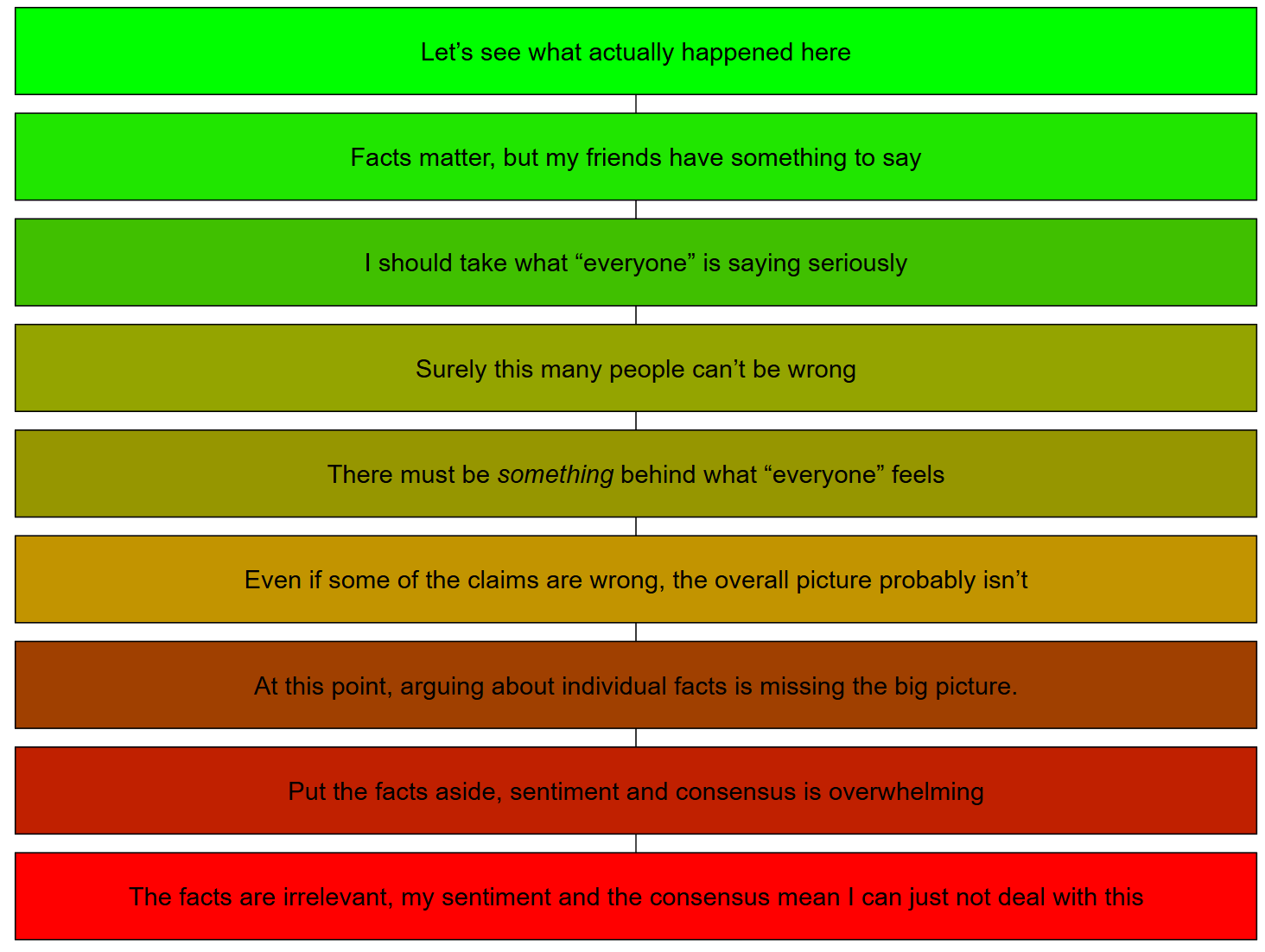
Not finished yet.
🔗 Manufacturing Consent
Consensus is made of sentiment, sentiment is made of belief, and beliefs are often made of complete nonsense.
The coercive operator manipulates the conditions under which other people decide what is true.
Not finished yet.
🔗 Directed Scrutiny
"The bad actions belong to the people I don't like."
🔗 Distorted Consent
"I do/don't want this" based on a false belief structure.
Here's a cup of liquid. You decide that you want to drink its contents. But if you're not aware that its contents are poison, your willingness to drink it is based on false information.
🔗 Examples of Coercive Systems
🔗 Machinery Overview

🔗 External Reputation Spiral
How someone's reputation can get caught in a feedback loop without them doing a single thing:

🔗 Internal Reputation Spiral
How reputation games create a feedback loop where the person's deterioration causes further isolation:

🔗 Carcinisation

[CC-BY 4.0 J. Antonio Baeza from Wikimedia Commons]
.jpg)
"[Carcinisation is] one of the many attempts of Nature to evolve a crab."
~ Lancelot Alexander Borradaile
Coercive systems often end up undergoing convergent evolution into one of a fairly small group of archetypal structures.
Even when there is a malicious actor at their core, these mostly weren't engineered deliberately; they're usually something which arises spontaneously from the set of incentives, desires and insecurities of each person. Decent people can end up participating in rather ugly systems.
In all coercive systems, the whole is greater than the sum of its parts. They are often made of individually reasonable components, but silently sum to something abusive, sometimes without everyone noticing.
🔗 Operator Continuum
Abuse can happen from a coercive system deliberately operated by one person.
It can happen from a system where no one person had ill intent.
And most commonly, from something in between.
🔗 Narrative Fragmentation
The process of narrative capture depends on no one person (other than the target) having the whole picture.
🔗 Self-Selection
Social groups built around coercive systems tend to have the property that the people in those groups are largely complicit with the system. This is simple self-selection: people who refused to play along with it were simply ejected before they could become a structural part of it.
This gives the social groups a kind of self-healing quality; a good default assumption is that anyone who was going to leave because of revelations of abuse would have done so long ago.
It also means that if you break ranks in a coercive system, you should expect many of its members to socially reject you.
🔗 The Secret Good People Club
"You can do whatever the fuck you want
But if you walk this way, you better fit in or fuck off
Fit in or fuck off
This is me, these are my people
We party harder than the others you know
We're born free, created equal
We can be friends if you respect the code
There's no room for hating in this life we love
It's either fit in or fuck off!"
~ Brennan Heart - F.I.F.O
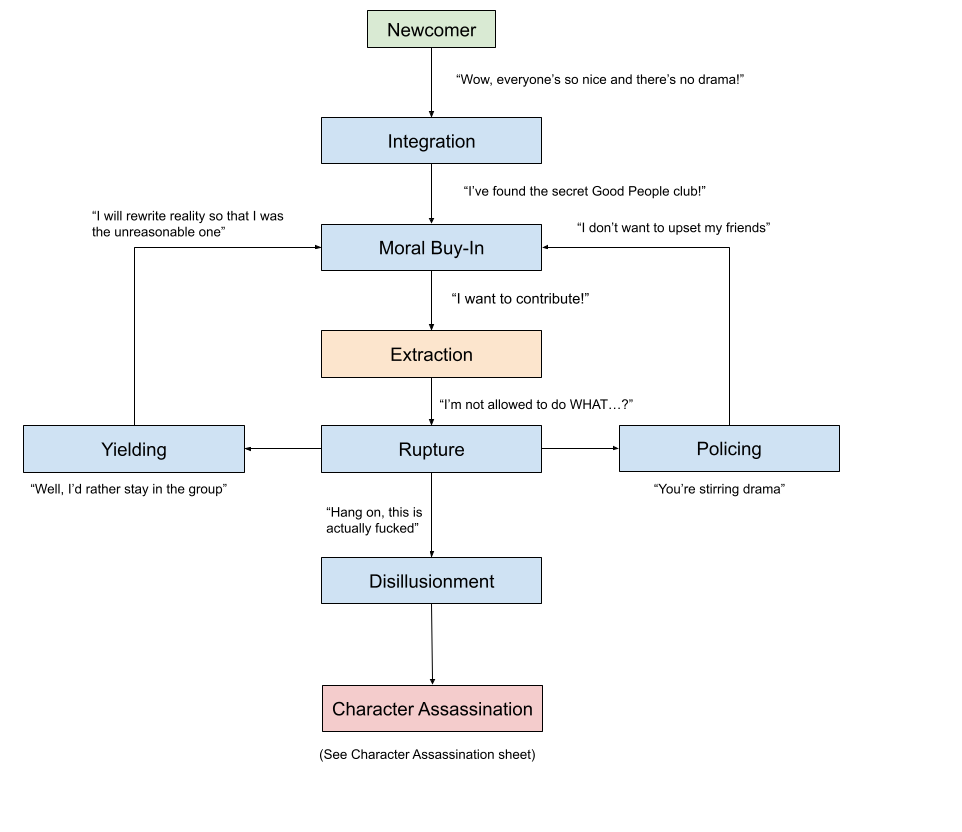
The Secret of the Good People Club is that a group's apparent harmony can hide invisible power and cost structures.
A group having norms and ejecting people who violate them is normal. The pathological part is when the invisible power and cost structure becomes lopsided, concealed, and enforced to protect some members and actively punish others. This is a particularly sinister form of power because the enforcement mechanism is embedded in ordinary social life and rarely looks like coercion from the inside.
This mechanism particularly tends to turn up in sectors where workers remain in roles long-term, there's a formal hierarchy and informal loyalty counts for much: academia, medicine, policing and legal, military, mining. The more expensive it is to leave a network, and the more your future depends on the judgement of people inside it, the more powerful its invisible cost structure can become.
🔗 Toxic Positivity
🔗 What Is Not A Secret Good People Club
Not finished yet.
Formal analogy: pathological accommodation.
🔗 Attention-Status System
This is more of an org chart than a workflow:
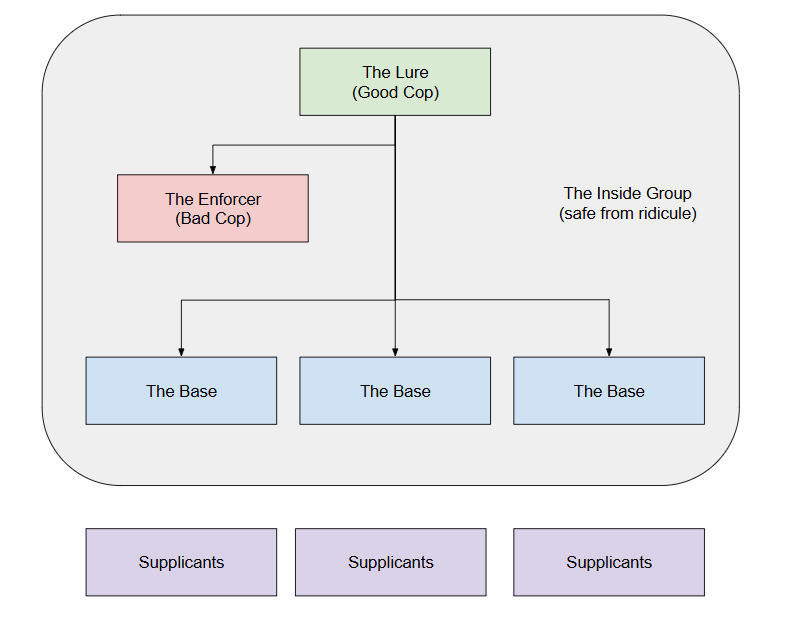
This structure was catapulted into the public consciousness via the film Mean Girls, but in reality it is gender neutral. I was surprised to find out that many massively-multiplayer video games are infected with it.
It is a coercive system where there's a desired "lure" who is desired, high-profile and attracts attention, and then has an "enforcer"/"bulldog" who attacks any who approach the leader without the supposedly appropriate supplication. Optionally, the "base" then laugh at the person, creating a social consensus within the group.
It's a really gross little machine which exists to create perceived status for the "inside group".
A common variation is deniable: the lure retains clean hands and doesn't directly lead the enforcer.
🔗 Coercive Fusion
Despite how oddly specific this might sound, it's actually one of the most common patterns I've come across.

The basic concept of fusion is that the operator wears multiple hats and collapses role boundaries which should be separate. For example, they may set a personal boundary then enforce it with institutional power.
The problem is not wearing multiple hats itself – it's using the authority from one domain to enforce a grievance from another.
One of the common versions of this ties in to the operator's relational territoriality: "don't talk to 'my' women" is framed as a personal boundary, but the enforcement isn't personal: it's being exiled from a community, getting fired from a job, or kicked out of a sharehouse.
Operators often hold onto exclusive gatekeeper status for this reason – it inappropriately gives them unlimited de facto personal power over a group. This status doesn’t merely increase influence, it converts social infrastructure into private property.
Another common variant pathologises any conflict at all, which the operator justifies controlling by saying they're "minimising drama" when in reality they're suppressing resistance. This is a mechanism operators use to control which grievances can be spoken at all, allowing them to rapidly isolate anyone who might threaten their grip on social power.
This manifests in very ugly implications: "don't cause drama or I'll fire you, and by 'cause drama', I mean challenge me." The sentence is never said aloud; it hangs over the power structure silently.
The personal grievance will be laundered through "neutral" things like safety, professionalism, or community health.
These approaches take advantage of agreeableness and conflict aversion among bystanders to enforce their will on the entire group; if everyone in it takes the "path of least resistance" and isolates anyone "starting drama" then power becomes particularly lopsided.
🔗 What Is Not Coercive Fusion
Someone being a gatekeeper of a group as well as having friends in that group is not, on its own, coercive fusion. The defining characteristic is using power available in one role to enforce a grievance that belongs to another.
That's also not to say that conflict in a group should simply be ignored; it just has to be dealt with on the legitimate terms of that domain, rather than importing power from an unrelated one.
🔗 The Jungle Council
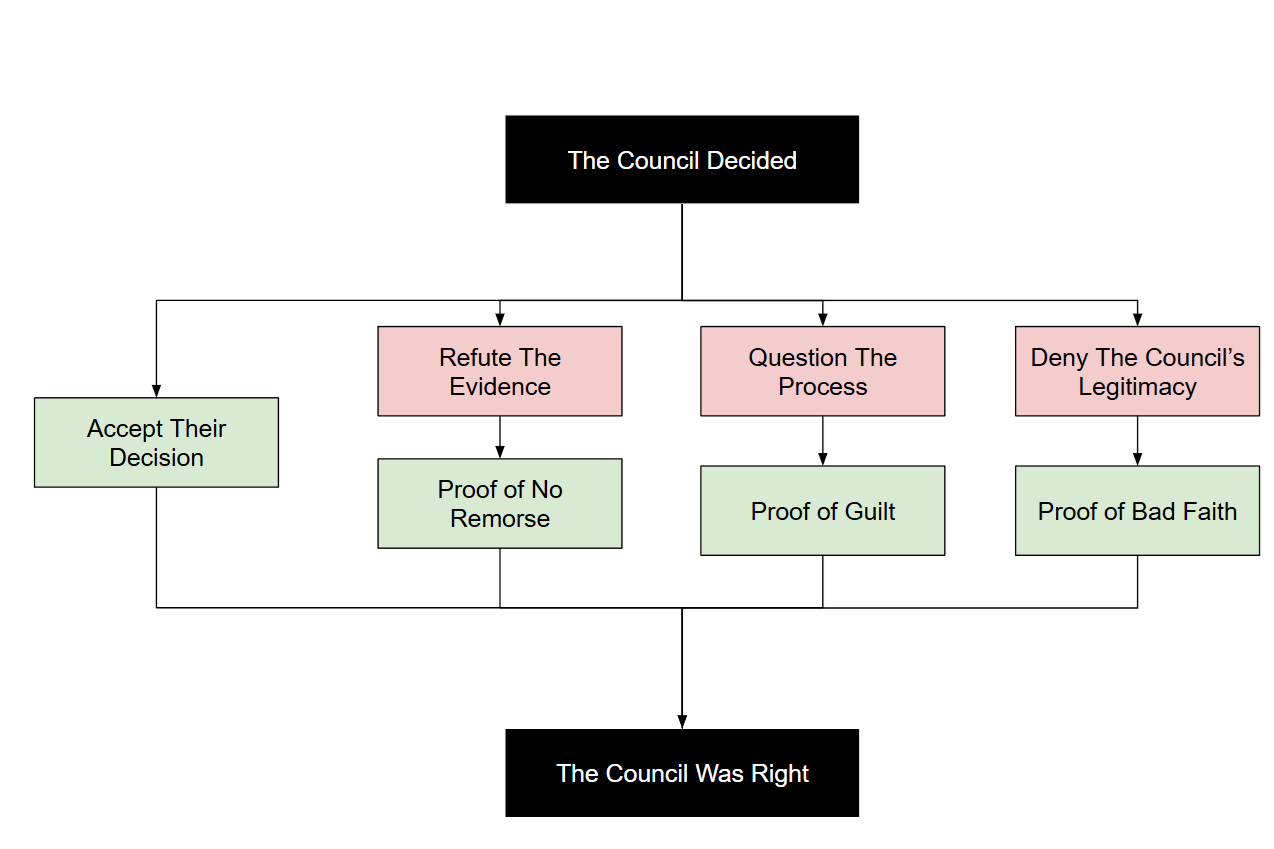
Institutional self-protection (usually in the domain of reputation) which is accountable to nobody. This construction is self-legitimising: the purpose of these groups is not actually to render a fair judgement, but to legitimise decisions informally made by an organisation's leadership in a deniable format.
These bodies commonly cause materially significant reputational damage without meaningful due process.
There is often a pretense of neutrality, but the framing of each case is usually directly inherited from the people who have a stake in the decision.
Inverting narratives so that the person who brought up an issue becomes the problem is an extremely common failure mode of these.
🔗 What Is Not A Jungle Council
Jungle Councils are a meeting of purpose and process; to qualify, a body has to match both.
Characteristics of a body which is not a Jungle Council might include:
- Transparency
- Capacity for correction
- Meaningful consequences for members of the body when it gets thing wrong
- A track record of complex situations being treated as complex
- A track record of outcomes which are contrary to the people who control the body
🔗 Kafkatrapping
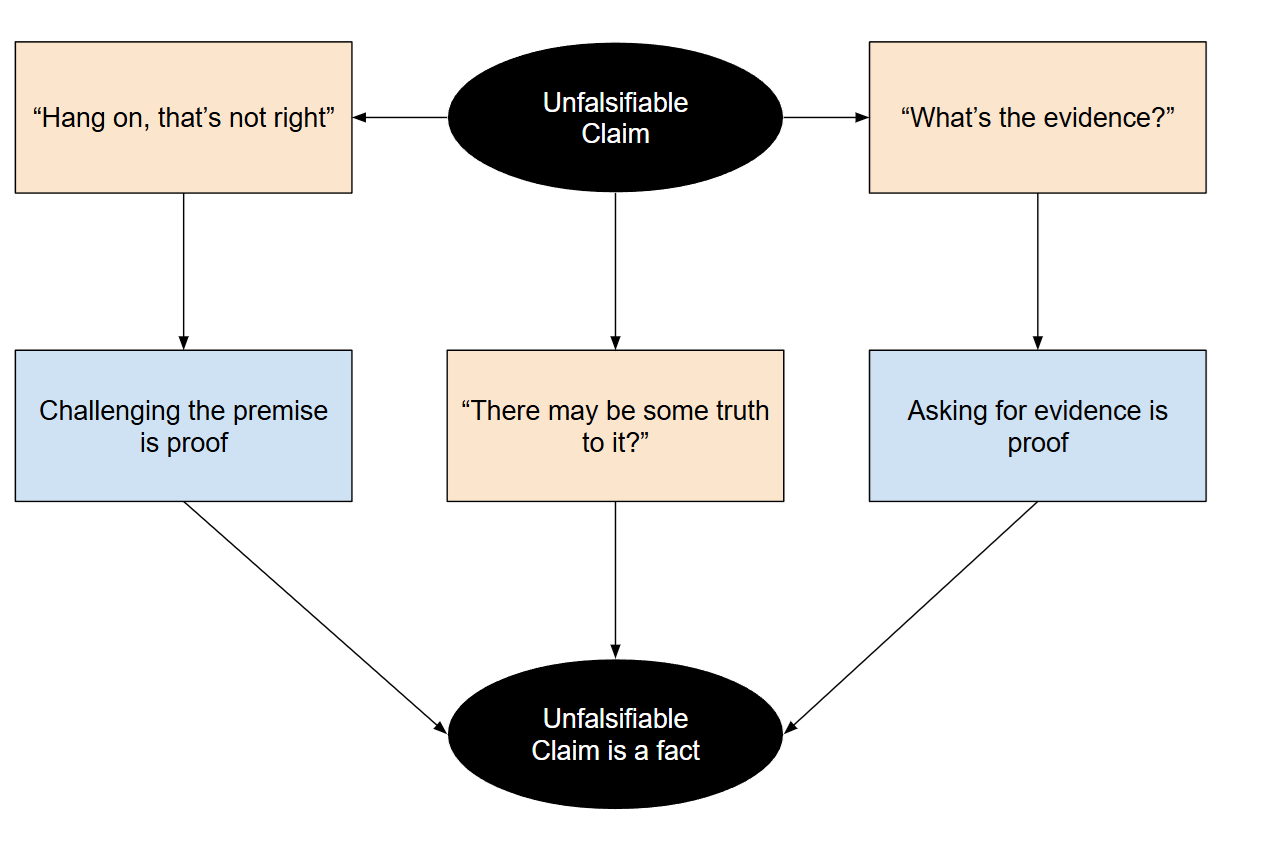
Named after the Franz Kafka novel The Trial. This construction is self-sealing: every attempt to orient oneself about what is actually being argued is cited as proof of the original accusation.
🔗 Conflict Displacement (Shooting The Messenger)
"Who is generating the problem" vs "Who is driving discussion of the problem."
The target becomes the most visible source of conflict because they are the person naming it. If a group uses amount of problem-talk as a proxy for amount of problem-causing, they can easily get the picture backwards.
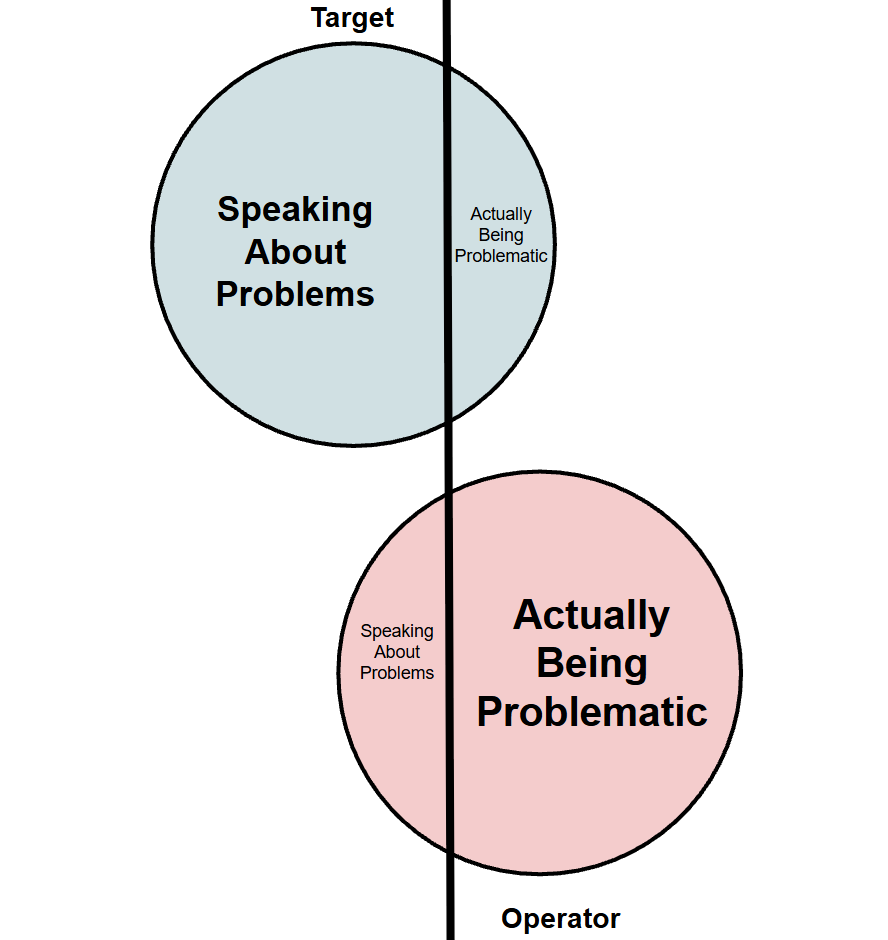
In particular: when an operator has achieved presence dominance, they are able to passively create a large volume of reasonable-looking drama-free behaviour because they're present. The target, being absent, can either speak up or not.
Not finished yet.
🔗 Status Anxiety Projection
One common response operators give when called out on their behaviour is to say that the person is "projecting".
Here is an example of what a projection mechanism actually looks like:
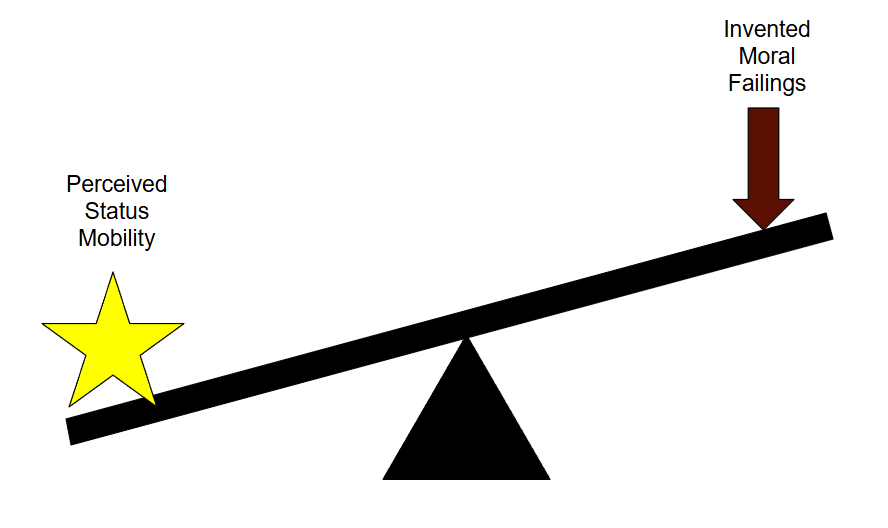
The projector sees something that they experience as the target gaining status. This makes them feel uneasy about themselves, so they start inventing stories about the target in an effort to protect their self-concept by "leveling the playing field." This is projection driven by status anxiety, where the person feels like they are losing "ranking" and need to rationalise that feeling to maintain their self-concept.
Because the counterweight is a fiction, it decays rapidly. Reality won't keep supporting it, so the person needs to keep churning out an endless series of ever-sillier belief structures to avoid the collapse of their self-concept.
The person will often keep exactly enough distance to provide "evidence" for their projections while not having to come into contact with reality.
🔗 Ranking Schemas
Status-comparative projection is often mostly a product of a social cognitive style where someone internally ranks people they interact with into a hierarchy according to some criteria of valued traits.
Despite the extreme diversity of surface presentations, the insecurity underlying a status projection is usually one from a fairly short list:
- Competence (intelligence, talent, capability, creativity)
- Desirability (beauty, youth, appeal, being chosen)
- Prestige (success, recognition, influence, status symbols like cars)
- Resources (wealth, possessions, security)
- Belonging (connectedness, popularity, centrality, children)
- Moral fibre (goodness, generosity, altruism)
- Autonomy (freedom, independence, lack of constraint)
The projection becomes the answer to the question "if they have this trait, what does it say about me?"
If everyone exists on a giant ladder with other people either above or below, and someone now clearly outranks us on one ladder, how do we reconcile that with our sense of self-worth?
The nature of this projection is that the projector claims that the target of the projections is the one concerned with status, which easily becomes an unfalsifiable claim. The construction is exactly backwards, and this allows the projector to convert any conceivable response into evidence of their projections.
🔗 Reality Orientation
You dye your hair red.
Your friend says your hair is black.
What happens now?
There is a wide range of productive options, most of which fall into two categories: measure and qualify.
There are many ways we can measure the colour to create a fixed truth in the context of some metric. We can take a photograph of your hair and look up the RGB values of the pixels in it. We can get paint swatches in a range of colours and put them next to the hair. We can go to a hair stylist and ask what they would consider it.
There are equally many ways we can qualify the judgement to create a relative truth. We can look at the hair under a range of different light sources, maybe see if it glows under UV light, or through different types of glasses. We can compare it to other heads of hair and say it's more black or red than them. We could do a study where we flash up an image of the hair for 0.01 seconds and the person writes down the first colour that comes to mind.
All of these assessments are reality-oriented: they are an attempt to converge on some kind of external truth. The disagreement is ultimately tethered to the material object and possible interpretations of it.
Narratives that arise as the product of projection are not reality-oriented.
These narratives are usually unfalsifiable and any attempt to anchor them in reality is likely to be cited as evidence for them.
A projector who has (for example) insecurities about their intelligence might twist it like this: if the projector says "you really think people with black hair are less intelligent, don't you?" the debate is now about the other person's internal experience, which is something they cannot possibly provide proof of. When they respond with "um, no, that's wrong, I don't think that at all" the projection machinery converts that into proof of the claim: "see! I have black hair and you think I'm stupid!"
The hair is no longer the topic. It was used as a lever to create an unfalsifiable claim about feelings the projector did not want to own. A factual dispute has been hollowed out and filled with someone's internal tensions.
Importantly, the projector twisted the topic so that their target is cast as the one who was excessively concerned with intelligence.
🔗 Speed
Something a little surprising about this form of projection is that it can begin very quickly:
"He bought a Bugatti Veyron." Immediate response: "It's gone to his head."
"He's been seeing Belinda too." Immediate response: "This is a cult."
"Her startup secured a million-dollar investment." Immediate responses: "She's looking down on us." "She has a fragile ego."
The complex network of rationalisations takes time, but the projection itself can be a kneejerk reaction. The process of inverting the tension so that the target of the projection becomes the one obsessed with status can happen extremely quickly.
🔗 Completely Impossible
Engaging with these projections is a bizarre, exhausting and pointless experience, usually involving lots of kafkatrapping. The person has constructed a cognitive blindspot, and trying to get them to explain what the actual problem is just results in going around and around in circles (and claims that the fact that you're asking is proof).
The experience is surreal. Sometimes it feels like they are continuing an argument they'd been having without you, which – in a sense – is a decent approximation of what's happening: the conflict had been with the symbolic version of you they'd been carrying internally. The argument began long before you actually exchanged a single word about it.
Some of the most fascinating discussions I've had involved a projector engaging in detail about projection mechanisms with regards to other people, but their brains seamlessly editing out any notion that they may be engaging in it themselves. The loss of insight is often quite narrow and watertight.
🔗 A Cult Of One
Not finished yet.
🔗 Status Minimisation
Not finished yet.
🔗 The Sickness
People amputating parts of themselves to fit into social and economic structures they feel they have no choice about, then resenting people who didn't have to do the same.
Not finished yet.
🔗 What Is Not Status Anxiety
Status anxiety is specifically for upward movement of social milestones.
Someone having a cool idea or a cool project is not that in itself.
🔗 Avoidance
Avoidance mechanisms mostly only differ in what they do to scrutiny:
- Table-turning redirects it.
- Dismissal scripts terminate it.
- DARVO inverts it.
- False symmetry flattens it.
- Sunk-cost avoidance makes avoiding it cheaper than examining it.
- Disengagement simply abandons it.
The central underlying escape hatch is hypocrisy – the idea that the person raising an issue exhibits the same problem at least as badly. Avoidance mostly handles uncomfortable asymmetry by manufacturing comfortable artificial symmetry to replace it.
The hypocrisy is backed up by a willing suspension of disbelief, where the person simply assumes the precepts for the hypocrisy must be true because they're more convenient and comfortable than fact checking.
🔗 Table-Turning
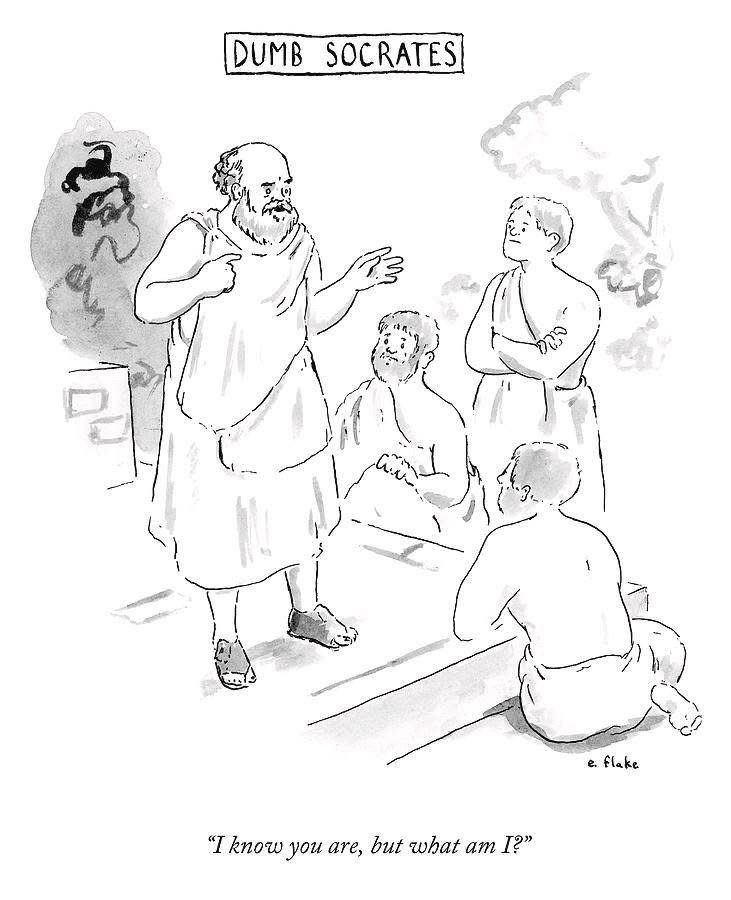
Emily Flake - Dumb Socrates (reproduced with permission)
🔗 Introduction
Table-turning is a very common toxic communication style that many people use as a way of handling perceived criticisms or attacks. The central idea is to respond by redirecting the topic of conversation back towards the other person.
It exists on a wide continuum: sometimes it's very clear cut and simple, and other times it's difficult to clearly identify.
The response overwhelmingly takes the form of stating, implying or insinuating that the person is being hypocritical. This is likely because it takes nearly no effort – the argument has already been made – but has a high emotional return.
🔗 What It Looks Like
Person A raises a concern or problem. Person B replies with: "You're one to talk," "same goes for you," "that's a bit rich coming from you," "you should take your own advice" or "what about your XYZ?"
Or simply repeating their words back at them.
And my favourite real-world example: "Sure, I'll stop table-turning, but you have to stop as well!"
It can consist of bringing up an unrelated past incident too. It often involves considering something as analogous to something an operator is identified as doing. It also often involves echoing words or phrases used in the initial concern.
Another common version is to latch onto a single word or phrase the person used and emphasise it endlessly in an attempt to imply hypocrisy. This often looks like: "Hmm yes, XYZ, that sure is a problem isn't it," or "interesting that you mention XYZ. Very interesting." In this variation, the operator does not accuse or rebut; they seize on a single word and load it with as much insinuation as they can.
🔗 The Elephant In The Room
The most common outcome of any exposure of an operator to the concepts in this book is them arguing for hypocrisy: no, you are the one who does these things. This is such a predictable response that it's worth addressing directly.
This section is not finished yet.
🔗 A Fragile Facade
Any attempt to litigate any actual hypocrisy (or lack thereof) is almost invariably met with something other than an actual argument – things like disengagement, character attacks or impressionistic "vibes". This is because this technique is fundamentally a form of sophistry with no actual substance to it; the goal is to focus the discussion on a different person, not to actually make an argument. In short, it's an attempt to derail the discussion rather than make a point.
🔗 Independent of Topic
A large part of what makes this a toxic communication style is that it is completely independent of the actual topic – you can make these replies to basically any concern and the structure of the interaction doesn't change at all. The response is completely disconnected from actually addressing what is being raised.
🔗 Never Defend, Only Attack
This strategy naturally evolves out of feeling like there is nothing to gain and everything to lose by defending a criticism. It therefore seeks to respond to any attack with a counterattack – placing the other person in a defensive position.
The counterattack doesn't have to make sense. It doesn't have to be based in anything and doesn't have to make any actual claims – even just a vague insinuation is fine. All it has to do is shift the focus so the other person is the one defending.
🔗 It Is Often A Fallback
Defence mechanisms to perceived attacks exist in layers like an onion. Some people lead with table-turning, but some people keep it deep in their stack as a late- or last-resort option.
This makes it more effective, because if they only pull out the trump card when nothing else is left, it preserves more of its power and feels more like they were trying to politely avoid pointing out the hypocrisy.
It is still equally toxic wherever it sits in the defense stack.
🔗 It's Kind Of Addictive
What's particularly problematic about this style is that it feels like you're making a good point. It feels like you undermined the person's argument, and your brain gets the reward feeling that it would have from actually picking it apart.
When they have a satisfying answer to every possible argument, and it always works, many people naturally tend towards using it more and more. It often becomes a default.
🔗 Cognitive Consequences
The upshot of regularly using table-turning is that your ability to hold yourself and others to account atrophies: if the outcome of conflict is the same regardless of what the person has actually said or done, the person's choices no longer matter. They cannot get anything right or wrong – the outcome is the same regardless.
This is absolutely devastating to a person's integrity, and their internal ethical framework can fall apart alarmingly quickly.
🔗 It Makes You A Worse Person
You owe it to yourself to catch this behaviour and to point it out in people you care about. There is effectively no upside to doing it other than feeling gratified during conflict. The long-term consequences of engaging in it are deeper and more serious than may be obvious: it structurally compromises your values and moral foundations.
Let's all do better.
🔗 Avoidant Table-Turners
Their basic position: "I don't care whether what I'm doing is right or wrong, I just want to be out of the firing line."
This group is often powerfully, intensely attracted to the idea that anyone who says something they don't like (or is loud about an uncomfortable topic) is a hypocrite.
Imagine the following exchange:
"Yeah, but you do those things too."
"Um, no I don't, and it's really easy to prove. I'm happy to prove it right now."
"Sigh. (disengages)"
The move didn't cash out, so they just bailed.
Someone who responds to failure of their table-turning with avoidant shutdown is really going to struggle with ethically complex situations, or even ethically simple situations where a manipulative actor is present.
🔗 What Is Not Table-Turning
There's a superficially similar move which is not evasive at all.
When a person with power over you imposes a standard they do not follow, applies rules asymmetrically, or makes a demand which cannot reasonably be met, pointing back at that inconsistency can be the most direct way to name the real issue.
The difference is: does bringing up hypocrisy function to avoid the substance of a concern, or to reveal the substance of the concern?
Pathological table-turning works by substituting "what about you?" for an answer.
The non-pathological form works by showing that "what about you?" is in fact part of the answer – because the rule being enforced is not a neutral rule, but a weapon, a double standard, or a demand for unilateral compliance.
In other words: if the reversal is used to escape accountability, it is deflection. If it is used to show that the accountability frame itself is corrupt, asymmetric, or fraudulent, it is exposure.
This matters most in power-imbalanced situations. A subordinate, patient, child, prisoner, employee, or abuse target may need to point to hypocrisy not to dodge the issue, but to demonstrate that the issue has been framed dishonestly from the outset.
Used carefully, this can be a legitimate and powerful move. But its purpose is different: rather than being there to derail scrutiny, it's there to identify that scrutiny is being applied selectively, manipulatively, or in bad faith.
🔗 Example
A manager disciplines an employee for being five minutes late while routinely arriving late themselves and changing expectations without notice. Pointing to that inconsistency is not changing the subject; it is evidence that the "performance concern" is being used selectively.
🔗 Academic Angles On Table-Turning
- Tu Quoque ("You Too") – an informal fallacy usually treated as a subtype of ad hominem – but while this captures the appeal to hypocrisy, it misses the broader rhetorical function of transferring scrutiny away from the original claim. Basically, "you do this too" but as an explicit argument rather than a conversational attempt to redirect scrutiny.
- Whataboutism – a closely related rhetorical technique that shares the "look over there!" misdirection, but is broader generally than projecting hypocrisy and does not necessarily redirect scrutiny back onto the original speaker. Basically, "look over there!" but not necessarily at you.
- Countercomplaining – an umbrella term for handling any criticism or complaint with further criticisms or complaints.
Tu Quoque is probably the closest, but both it and table-turning have cases which exist outside the other. Table-turning allows the operator to put the target on defense without making an explicit "you do the same thing" argument.
🔗 Lived Experience On Table-Turning
🔗 Dismissal Scripts (Side Channel Attacks)
There is a world of difference between legitimate criticisms and substantive criticisms.
A criticism can be completely legitimate while having zero bearing on the substance of the issue.
The move is "say this thing so that you don't need to address the uncomfortable implications of what is being stated." Dismissal scripts are a sleight of hand to avoid an update without having to answer for the thing which would require the update.
The feeling is "I don't like this, make it go away."
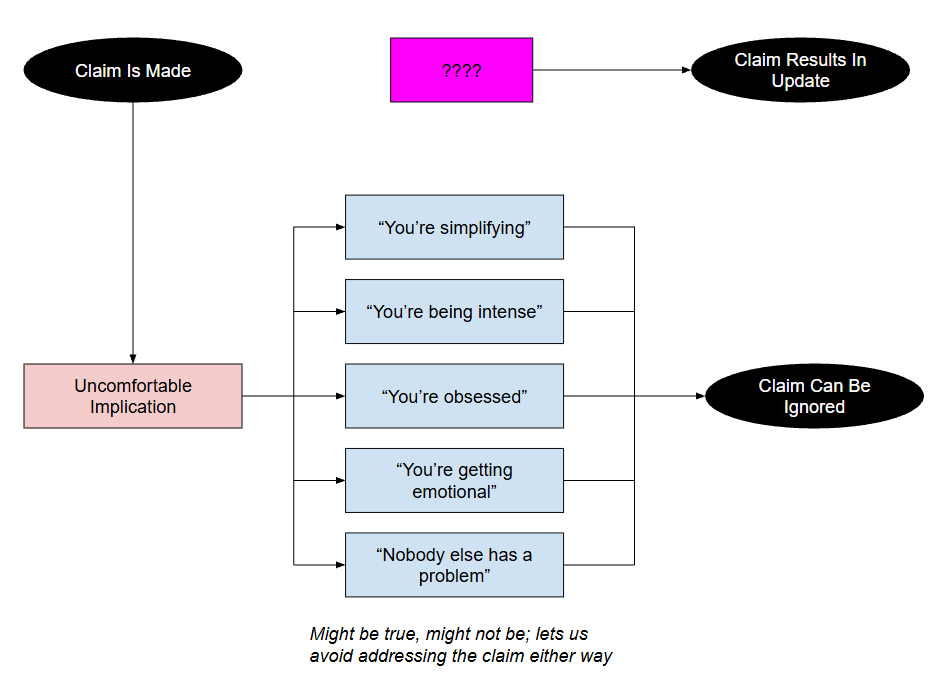
The array of options for doing this is dazzlingly huge, but tends to fall into one of a modest number of categories:
- Detail Level: "You're simplifying", "this is a generalisation"
- Emotional State: "You get emotional about this", "you're being intense"
- Healthiness: "this is an obsession for you", "you're paranoid", "this is toxic", "you're overthinking this"
- Motives: "You're on a vendetta", "you're campaigning", "you just hate them"
- Significance: "Who cares?", "why is it such a big deal?"
- Consensus: "Everyone knows...", "you're the only one who has a problem"
- Panic: "This is fucked." (block/delete)
The person doesn't have to establish that the argument is wrong. They just have to establish that the argument is too emotional, too obsessive, too unpopular, too simplistic, too unhealthy or too suspiciously motivated to warrant further attention.
If we dismiss the claim based on things which have nothing to do with its merits, we can always find a reason to avoid updating.
A particularly effective form of dismissal script is one where the subject of the criticism is unfalsifiable – where it is completely impossible to prove that it's wrong (most commonly, making the subject about the other person's internal state). Shifting the discussion to that topic ensures that any effort to litigate the matter will be completely unproductive.
🔗 What Is Not A Dismissal Script
Many of these criticisms have a time and a place where they're productive. The litmus test is: does this help clarify the original claim, or replace the need to examine it? For example, if a claim is simplified, then the healthy next step would be to build a more complete model, not dismiss the claim. If a claim is emotional or obsessive, it can still be reality tested.
People have a finite capacity, and at any given point in time they may not be able to have a challenging discussion. Dismissing something uncomfortable offhand is not a question of capacity: it's an attempt to make something difficult go away.
Not finished yet.
🔗 Academic Angles On Dismissal Scripts
Dismissal scripts are an expansion of Robert Jay Lifton's concept of thought-terminating clichés: the defining characteristic isn't that it's false or clichéd, but that it removes the requirement to examine the original claim. A dismissal script is defined by function rather than formulation, and consists of a statement which, whether it is true or not, nuanced or primitive, clichéd or bespoke, is simply irrelevant to the actual point.
🔗 DARVO 101
Weaponised victimhood. Playing the victim allows operators to access a wide range of formal and informal mechanisms to do harm.
Not finished yet.
🔗 What Is Not DARVO
🔗 Academic Angles On DARVO
🔗 Lived Experience On DARVO
🔗 False Symmetry
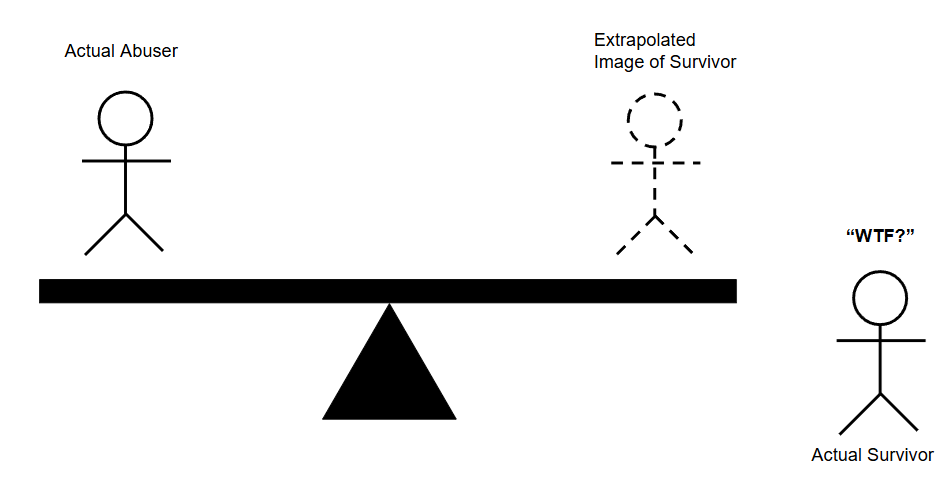
The basic construction is: the target is dismissed as an equal party in the abuse, but only based on an image the operator has constructed instead of reality.
The two parties are treated as equal and equivalent, but only when one is dominating the narrative through presence or narrative control. In other words: "you are just as bad as each other. I know this despite talking to the operator a lot and the target very little."
This plays into avoidant biases very strongly, because it's a comfortable explanation that lets them dismiss conflict as a big mess where everyone was wrong without having to examine the facts. It also dovetails with Conflict Displacement, because it lets them treat the person speaking up as the problem.
Meanwhile, the real person is sitting to the side wondering what the hell they are going on about.
If we assume both parties were equally in the wrong, we don't have to confront that we may be doing something monstrous by trying not to take a side. If one of them actually was the good guy in this, we have fucked up royally.
False symmetry is how mutuals/bystanders table-turn against reality itself; it allows them to collapse down inconvenient information which might threaten the comfortable conclusion – even if that information is obvious and well-known.
When one party is consistently making arguments that there is symmetry, the fact that the other party is mysteriously absent from these social settings apparently stops counting after a while.
Once the target is no longer present, the operators often aim to sell "look, it's messy, everyone was in the wrong in one way or another, it sucks, now let's forget about drama and have fun." That shit is like catnip to avoidants in particular: it's the easiest way for them to absolve themselves of knowledge or guilt about what they were complicit in.
Unfortunately, in the real world, there often is one party acting in good faith and the other not – but that's hard to see when the former has been mysteriously absent for long enough. Artificially enforced absence makes it very easy to overwrite the narrative with one which is comfortable but wrong.
False symmetry also dovetails neatly with hypocrisy projection: if the two people are just as bad as each other, then any criticism of the other party can trivially be described as hypocritical.
Mutuals/bystanders can become incredibly invested in symmetry narratives, because accepting that one side actually was in the right means accepting very serious implications about their own behaviour.
🔗 What Is Not False Symmetry
🔗 Academic Angles On False Symmetry
🔗 Lived Experience On False Symmetry
🔗 Why Good People Do Cowardly Things (Sunk Cost Avoidance)
If you've ever wondered why someone will spend years arguing why they don't need to spend ten minutes checking facts:
The reason so many mutuals are intensely averse to a ten minute fact check is not because they think the information is complex or difficult to digest. It's because they know accepting the facts will begin a cascading update that will impact every area of their lives and relationships: the consequences are seemingly endless.
The more they think about the implications of updating, the worse they feel. So they become progressively less and less willing to think about the consequences of their actions the further down the causal chain they go.
This explosion of implications rapidly becomes overwhelming, and the only option that viscerally feels possible is bailing on the discussion. They don't want to check the facts because it opens a trapdoor under their entire self-concept: every day they go on acting on the beliefs implanted by the operator increases the cost of returning to reality.

Worst of all, admitting the mistake this time can force someone to confront a much larger question: how many times have I done this before? Going back on their words now may reopen every previous judgement made through the same pattern of avoidance. So now it's not just one cascading update, but many.
🔗 Which One Of Us Has Been Asking For Fact Checks, Again...?
I want to give a little reassurance to targets here.
Mutuals will overwhelmingly be conditioned to say you are the one who needs to consider that you're wrong.
If the person who has been trying, over and over, to get mutuals to do a basic fact check – and they refused – said mutuals are really in no position to be claiming anything about what did or didn't happen.
🔗 Moral Courage
Moral courage is not the same thing as taking on all the world's problems.
Not finished yet.
🔗 Hatching Eggs
You can't hatch an egg by breaking it. People who aren't ready to understand social coercion can't be forced to.
Not finished yet.
🔗 What Is Not Sunk Cost Avoidance
🔗 Academic Angles On Sunk Cost Avoidance
🔗 Lived Experience On Sunk Cost Avoidance
🔗 Disengagement
"Drop everything and walk away" is a universally safe choice for someone who is sufficiently privileged.
When society provides everything you need elsewhere, you're not tied to any particular relationship or institution.
Many people are not so lucky.
🔗 What Is Not Disengagement
🔗 Academic Angles On Disengagement
🔗 Lived Experience On Disengagement
🔗 Avoidance Summary
Really these are variations on: "this makes me feel bad, but claiming hypocrisy makes it go away."
🔗 Operator Psychology
🔗 Narcissism
🔗 Informalisms About Narcissism
In mainstream culture, "narcissism" is almost entirely a pejorative for "I dislike this person". (See also: "main character syndrome", "fragile ego", "self-centredness", "self-obsession" or whatever other pop-culture surrogate for narcissism is in fashion this week).
This tends to be a consequence of moral counterweighting rather than personality structure: if someone actually did something bad, you would just say that. But "narcissism" is a value judgement and character assessment, which is often invoked to provide an easy answer to difficult questions.
🔗 Symptom Lists
Symptom lists for psychiatric and personality disorders, in the hands of laypeople, are in general worse than useless. They are actively misleading.
For example, symptom lists for hypomania mostly comprise completely normal entries that most healthy people experience at times, like "rapid speech", "sleeping less" and "lots of energy".
Symptom lists for narcissistic personality disorder are similarly made of qualities that the average person is overwhelmingly likely to feel comfortable assigning to anyone they have negative sentiment towards:
- Have an unreasonably high sense of self-importance and require constant, excessive admiration.
- Feel that they deserve privileges and special treatment.
- Expect to be recognized as superior even without achievements.
- Make achievements and talents seem bigger than they are.
- Believe they are superior to others and can only spend time with or be understood by equally special people.
- Be critical of and look down on people they feel are not important.
Notice in particular that many of these traits revolve around internal experiences and are either unfalsifiable or extremely difficult to validate accurately. Someone using these definitions for the condition can easily create self-sealing narratives.
Someone ticking the boxes of the above list in your mind does not reliably indicate that they are narcissistic. It usually just indicates that you dislike the person. The label becomes an excuse not to understand their behaviour.
Frankly, I consider the broad proliferation of these lists for psychiatric constructions to be quite irresponsible. This is a classic example, because the vast majority of the population would absolutely hear what they want to hear from this list and take it as confirmation for something it absolutely isn't.
🔗 Motivations
The label of "narcissist" gives us a culturally legible way to write someone off as a person and deposit them in a closed system: "why did they behave that way?" "Because they're a narcissist." "How do we know they're a narcissist?" "Because they behave that way."
If you find yourself wanting another person to earn the label, it might be worth carefully examining why.
In any case, we don't necessarily need to pin someone with a diagnosis to understand their behaviour: an analysis of coercive systems doesn't require a pathological label to garner useful insights – indeed, it's more effective without one. Understanding the actual mechanisms and network effects involved is a much more specific and useful approach than slapping a popular label on a person.
🔗 Lived Experience
🔗 Bizarre
"It's a bizarre experience, because it's hard for normal people to conceive of how others can be put together like that. I still find it hard to conceive."
~ Anonymous
🔗 Evil
"When they thought they had power over me, I saw a completely different side to them. They no longer had a reason to hide their intentions. It was messed up."
~Anonymous
🔗 Poison
"When I was a teenager, my girlfriend came around for dinner with my family, after which I had a significant medical response. While this was happening, my mother kept asking my girlfriend if she could take her home, because I was sick. She did not go home, and I recovered. Many years later I was reflecting on this, and I suspect my mother intentionally put an allergen in the food to trigger an attack and get rid of my girlfriend, who she didn't like. It's not a logical decision, but it matches the insistence that she could go. Worth noting: A response of that scale did not occur again after moving out of home.
Another time – after I was mostly estranged from my parents but attempting reconciliation – I asked my mother if she'd like to meet the foster child in my care, who was the most important thing in my life at the time. Her response was literally "What's the point, they'll be gone soon anyway.". I could not bring myself to remove them from my life for myself, but the impact of the children in my care seeing that relationship modeled made it an easy decision to do so."
~ Anonymous
🔗 Origins of Control
Something that has come up repeatedly in the testimony was extremely minor trauma in the operator's adolescence which they responded to by saying "never again" and building coercive systems to avoid repeating. The trauma is consistently on the order of magnitude of "my girlfriend cheated on me with my best friend in high school".
Not finished yet.
🔗 Survival
🔗 Public Shaming vs Speaking Up
Public shaming as a malicious action is a well known concept with a long history, and can absolutely be used as a method of control. That's not the topic we're examining here.
What we're talking about is when someone runs around spreading bullshit rumours about you behind your back, and you address them publicly in one go. This can include sharing their motivation for the bullshit rumours, which is usually something they did wrong where the rumours were misdirection from it.
🔗 Narrative Inversion
What's interesting is that a lot of people experience this action as the opposite of what it is. At the interpersonal scale, something loud and public can be emotionally collapsed into "controlling", but making false claims in this way is an impractically fragile and brittle way to harm someone's reputation – if everyone can see it, anyone who knows the truth can speak up.
When made at the personal scale, a public statement is a precommitment to its own truth. They do not guarantee truth, but they do bind claims to scrutiny in ways that private ones avoid.
By contrast, lying to people individually behind closed doors is something which scales over and over again, and even creates an incentive for them to hide it with you. This is what actual controlling behaviour looks like.
Some people will just hate you for doing it regardless. Many people will hate you for doing it when it exposes them, even if you were right to do so. Either way, the claim that this should have been private is an attempt to divert the narrative into channels where claims are much harder to verify.
"How could you say they did that!" apparently overrides "how could they do that!" for way too many people – when it's convenient to the story they want to believe.
Operators often aggressively moralise public speech even when it's right, because it takes away much of their playbook. Pay careful attention to who you see doing this. The common bias towards "low drama" and "keeping the peace" doesn't come from nowhere.
🔗 Conscience vs Exposure
When it comes to accusing someone of wrongdoing, you have to ask, is it "you did something wrong, and they are angry that you did it"?
Or is it "they did something wrong, and they are angry that you said so"?
Same deal with anxiety: "they are anxious that you are going to do something bad to them"
Versus "they are worried that you are going to tell others about the bad things they did"
If someone fears exposure, that fear may be entirely justified. These cases are not anxiety in the pathological sense, but a rational fear of being caught out for something they actually did.
Operators have a thousand ways of dressing up exposure injury as moral injury.
It's critical to understand that something feeling bad to someone doesn't mean the person who broached the topic actually did anything bad, but that one of the major movesets of a coercive type is to convince them (and others) that they did.
Of course doing bad things often upsets people. But doing good things that are against the interests of operators upsets them, too, and that's weaponising the same process. Sticking with "don't upset people, and stay with others who don't raise issues" can allow you to become complicit in monstrous things.
🔗 Contagion
"The amount of energy needed to refute bullshit is an order of magnitude bigger than that needed to produce it."
~Brandolini's Law
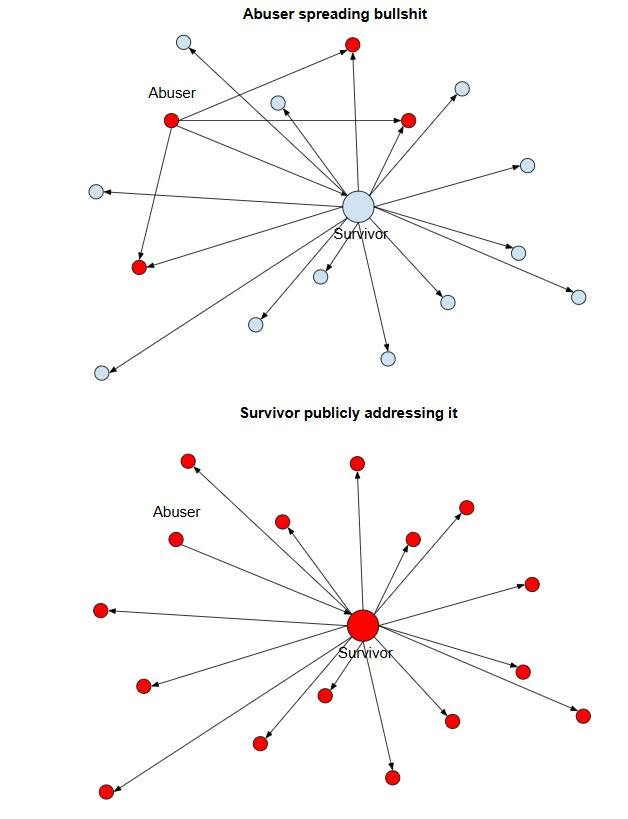
The only person who can address all of your network all at once is you.
How coercive operators exploit the targets' assumptions of good faith in their network.
The target treats the network as a tribunal: people will hear the allegation, examine the facts, and revise their beliefs in good faith. The coercive operator treats the same network as an infection surface: their objective is not to win a fair debate but to seed enough suspicion, ambiguity, and social risk that others begin carrying the narrative for them.
The operator engineers their stories to be outrageously wrong so that the target feels the need to correct them.
🔗 Complicity
"If you're hiding a friend in your attic, and his mortal enemy comes to the door and asks if he's there, the question is a lie. They're really asking "can I come in and kill your friend?" "No" is a completely truthful answer to that question. A lot of life works like this." ~kzl (qephatziel on Twitter/X)
Not acting is a choice too, and it has consequences too.
For the complicit, it might mean something quiet and corrosive is accumulating in the background – the knowledge of self-betrayal, the fact that "I knew better", and the way truth tends to charge interest when you run from it.
Stepping back and saying "this is too much, I'm out" when abuse is happening is a gobsmackingly selfish thing to be doing: you are fobbing the costs off onto the one person who did nothing wrong. They do not, in any way whatsoever, owe you a jot of forgiveness for doing this.
Many people have the luxury of playing life on "casual" mode, and jump up and down when you force them to realise that this has consequences for people who aren't so lucky.
Your responsibility begins when the consequences for the target do.
If you don't like the consequences of your actions, change your actions.
🔗 The Reality Of What The Target Is Dealing With
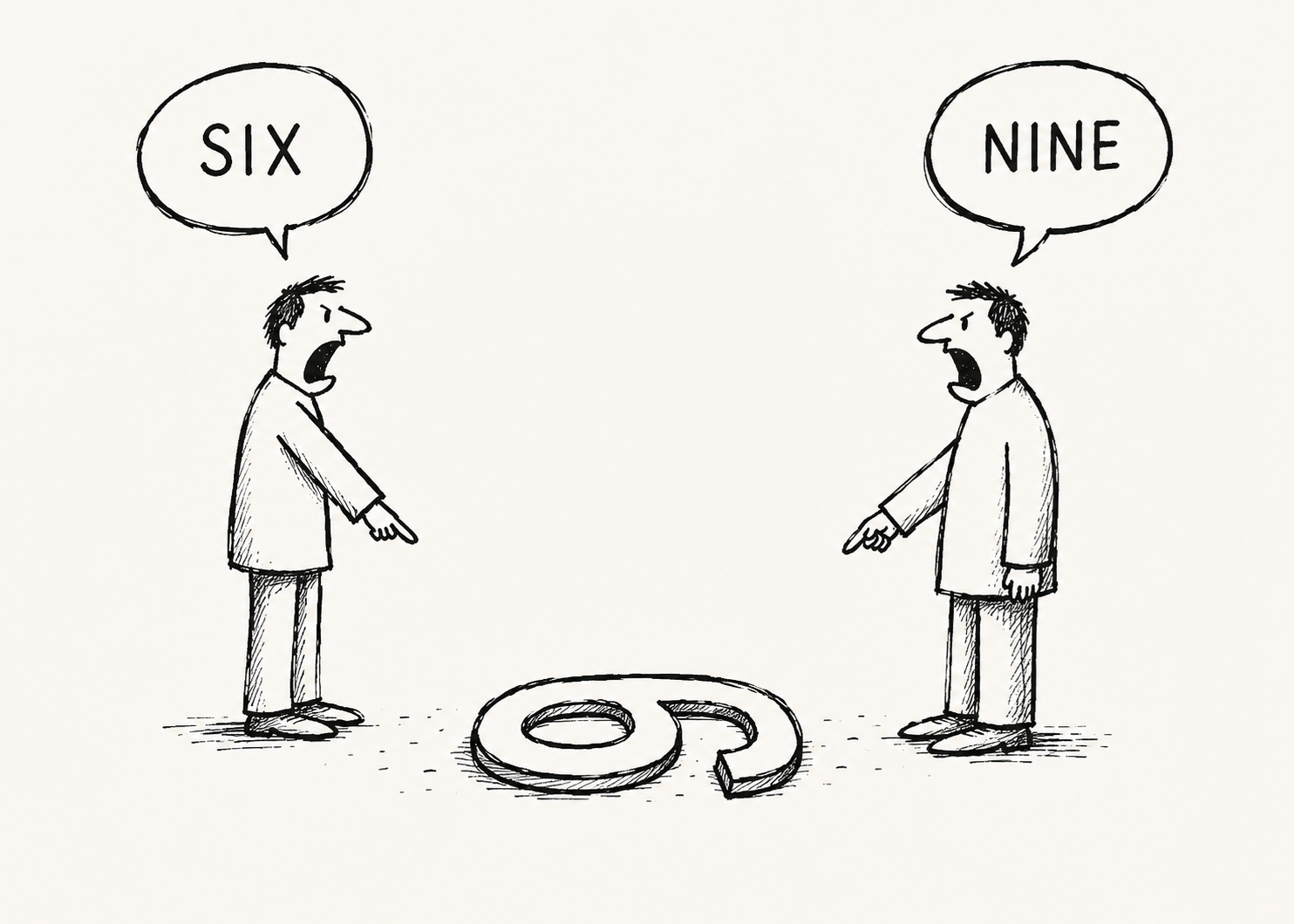
"But one of those people is wrong. Someone painted a six or a nine. They need to back up and orient themselves, see if there are any other numbers to compare to. Or they can ask someone who may actually know."
~ The Daily Scar
There may actually be a right answer, and if you look past the fog into the surrounding context, you'll probably find it in the people who have been through this before. Orienting yourself is only impossible when you are caught in the operator's narrow framing.
If you start following the trail of wreckage, you will often find yourself oriented much faster than you'd expect.
Unfortunately, taking the "path of least resistance" has actual consequences. They just land on the people who have been framed to you as "difficult" so you can easily dismiss them.
Despite comprising of petty tricks, the consequences of all of this are often far more serious than most people realise. Mental health, employment, housing, and family can all be damaged or destroyed, often falling in sequence like dominoes. The loss of protective resources can even render the person vulnerable to legal threats.
Targets often end up in extremely serious situations – many lose their entire support system before they even understand what was done to them. Ironically, they often end up particularly susceptible to secondary coercion from others who sense this vulnerability.
This is not alarmist; it's all well documented and understood. Most people just haven't seen the other side of it yet.
The whole process happens with the operator holding plausible deniability, and that's the whole point.
Telling the person to relax or "chill" is not de-escalation – it's demanding that they choose the form of harm that causes the minimum of inconvenience to the people who are complicit. Silence does not come with no cost, the game is just set up so you're not the one paying.
🔗 Doing What's Easy vs Doing What's Right
A consistent theme in the investigation has been: the target gets put under the microscope and every minor thing becomes evidence against them, but the operator's giant whopping campaign is invisible to anyone weighing the "balance of probabilities" because of its deniable nature.
The target is not being "dramatic". They're just being abused in a way you can't see.
🔗 Targets Are Not Angels (And Don't Have To Be)
Not finished yet.
🔗 Reasonableness Scripts
People who are complicit in this form of abuse do not usually identify as "helping abuse someone."
What they say usually looks more like:
- "I'm avoiding drama."
- "I'm staying out of conflict."
- "I'm protecting my peace."
- "I'm being reasonable."
- "I'm staying neutral."
- "Silence is golden."
- "I'm being mature."
- "I don't want to get involved."
Your self-image of innocence is one of the foundations that this abuse is built on.
🔗 Local Optima
Avoiding discomfort or perceived risk when you don't have past experience of what's on the other side of it is completely normal. Growth happens when the discomfort of your current situation is greater than that of changing it.
Any time anyone does something differently it's a tiny victory against stagnation, and we are forced to weigh up how much each battle might cost.
This makes complacency or avoidance less of moral failings and more of a lack of trust and experience as to what happens when people put effort into difficult things and set them right.
🔗 Some Helpful Habits
Triangulation thrives on private, unfalsifiable claims.
Stop and think:
If people are polarising, who is ending up on each side? Are targets and former mutuals clustering together, or being quietly scattered and isolated?
Did I actually see this person say or do the thing in question, or was I told about it? If "evidence" was provided, was it shown openly in a falsifiable way, or quietly in private when my guard was down?
Is there strong pressure not to tell the person what has been said about them, not to ask them directly, or not to question the story? Who benefits if I don't?
Do all roads in this topic mysteriously lead to "keep your distance"? Am I being handed simple labels like "drama", "manipulative", "intense", "toxic", "obsessed", or "campaigning" so I don't have to think any further?
If a person has "changed", did I actually see that change myself, and is it even the kind of thing that usually changes?
If there was conflict, did I witness it, or am I accepting someone else's after-the-fact account?
If I later discover the story was incomplete or misleading, will the person telling it say "I may have been wrong", or will that somehow become more proof that the target is dangerous?
Does anyone push back if I ask questions regarding claims about someone else? Is it always ultimately the same person?
If you are "staying out of it", did you decide that before or after you knew the whole story?
Slow down. Compare accounts. Examine the sequence. Ask who controlled presence, information and access, and who benefited. Decide what evidence could disprove the story.
🔗 A Tidy Box
Many, if not most people who haven't lived coercion prioritise putting conflict into a tidy little box they hopefully never have to open again.
🔗 Pick Any Two
- Core values of a decent person
- Acknowledging what the operator has done
- Remaining friends with the operator (and all associated perks – and there are almost always perks)
🔗 Ammunition Stockpiling
It's like doomsday prepping, except the apocalypse is accountability.
🔗 Hoarding
"I drink and I know things."
~Tyrion Lannister, Game of Thrones
It's completely normal to create evidence of your interactions with others – hell, in the modern era it's basically impossible not to. Most messaging services keep a log of messages on at least one side whether you like it or not. It's also completely normal to create a record when someone does something obviously problematic to you.
What we are talking about is not that.
A surprisingly common thread among operators is: they silently stockpile information. Not TV shows or music, but detailed and organised logs of every interaction they have with everyone. Specifically, they silently stockpile potentially damaging information about others, even people they don't have active conflict with – though often they'll keep a copy of everything across all time periods as cover for it.
What is often dismissed as harmless-but-eccentric hoarding behaviour takes a much darker turn when you take it in the full context. If they see something problematic, they will not speak up or confront anyone. They'll just keep the ammunition available for any time they might need to control that person.
One common tell is that the operator does not set boundaries around a person's behaviour when they're engaging in incriminating activity – they do not tell them to stop. Their silence has nothing to do with safety or uncertainty: it is simply a technique to gain as much ammunition as possible. Rather than saying that a behaviour is not okay, they simply let the behaviour run its course to maximise the amount of damaging information that's generated.
In a sentence, the strategy is "say nothing, collect everything, wait for the moment; then show it in-person on the spot to create an impression with no footprints."
🔗 What Is Not Ammunition Stockpiling
Normal record-keeping during conflict is contextual and proportionately bounded to the concern. Ammunition stockpiling simply becomes a default even when there is no conflict – it becomes a kind of insurance against betrayal: it's an attempt to have a coercive response prepared for any conceivable eventuality.
Keeping a longitudinal record of your abuser is not ammunition stockpiling; that's contextually appropriate and proportionate. Even keeping extensive records as a reality test to make gaslighting harder is fine – ironically, it's a pretty critical part of surviving coercion.. The specific behaviour we're talking about here is keeping extremely detailed and extensive logs of interactions with everyone, just in case you need leverage later.
🔗 Lock And Load
I have never seen one of these people publicly share any of the contents of their hoard, and since that would make it very clear what their process is, they doubtless use it (likely out of context) behind closed doors as a way to get others on-side. Since these coercive processes generally rely on private narratives and plausible deniability, publicly sharing their ammunition provides a chance for the target to provide context and the broader community to question why the operator was hoarding this information in the first place – especially if it happens more than once.
The application of the ammunition is usually as an enhancer to other techniques they use together. When a mutual's defences are down, this kind of "evidence" can be an extremely convincing bona fide even if the framing is blatantly deceptive. Critically, the objective is to convince the mutual in a way where there is no permanent trace of what they shared, and which will make them feel uneasy about discussing it with the target.
🔗 Sources
Spy-game bullshit. Some operators try to get former friends to spy on you and your social media.
The initial process often revolves around playing the victim (DARVO) in an attempt to get mutuals on-side. Once they've started reporting on the target, the incentives point strongly towards them continuing to do so.
Recruiting "sources" actually does a double duty: it creates a sunk cost where admitting they made a mistake means confronting how fucked up their behaviour has been. Once someone has bought in, it becomes harder to acknowledge their mistake because they’ve compounded it repeatedly.
In short, this becomes a loyalty enforcement mechanism as much as it does a means of obtaining actionable information.
🔗 Extraction
Operators also often interrogate the people surrounding targets in an attempt to find damaging information.
🔗 Responses
The most powerful response to this crap is also the simplest: name it. The more people who are aware of these tactics, the less power they have.
🔗 Radical Transparency
Being one hundred percent honest here, I am not totally convinced that radical transparency is actually a practice as opposed to a very specific manifestation of autism. It does, however, create some absolutely hilarious moments when operators endlessly double down because they think everyone has secrets and that if they're buried this deeply they must be extremely damaging.
🔗 Territoriality
One of the common threads I've repeatedly seen from people operating coercive interpersonal styles is territoriality: claiming "ownership" of certain concepts, people, or areas of expertise. This is the opposite of what a polymath or healthy polyamorous person does, which usually looks more like "there's plenty to go around, let's share!" A territorial individual jealously guards "resources" they don't actually have exclusive rights to. I've written a section on this, but it's not finished yet so I'll just leave a note signposting the topic.
🔗 Relational Objectification
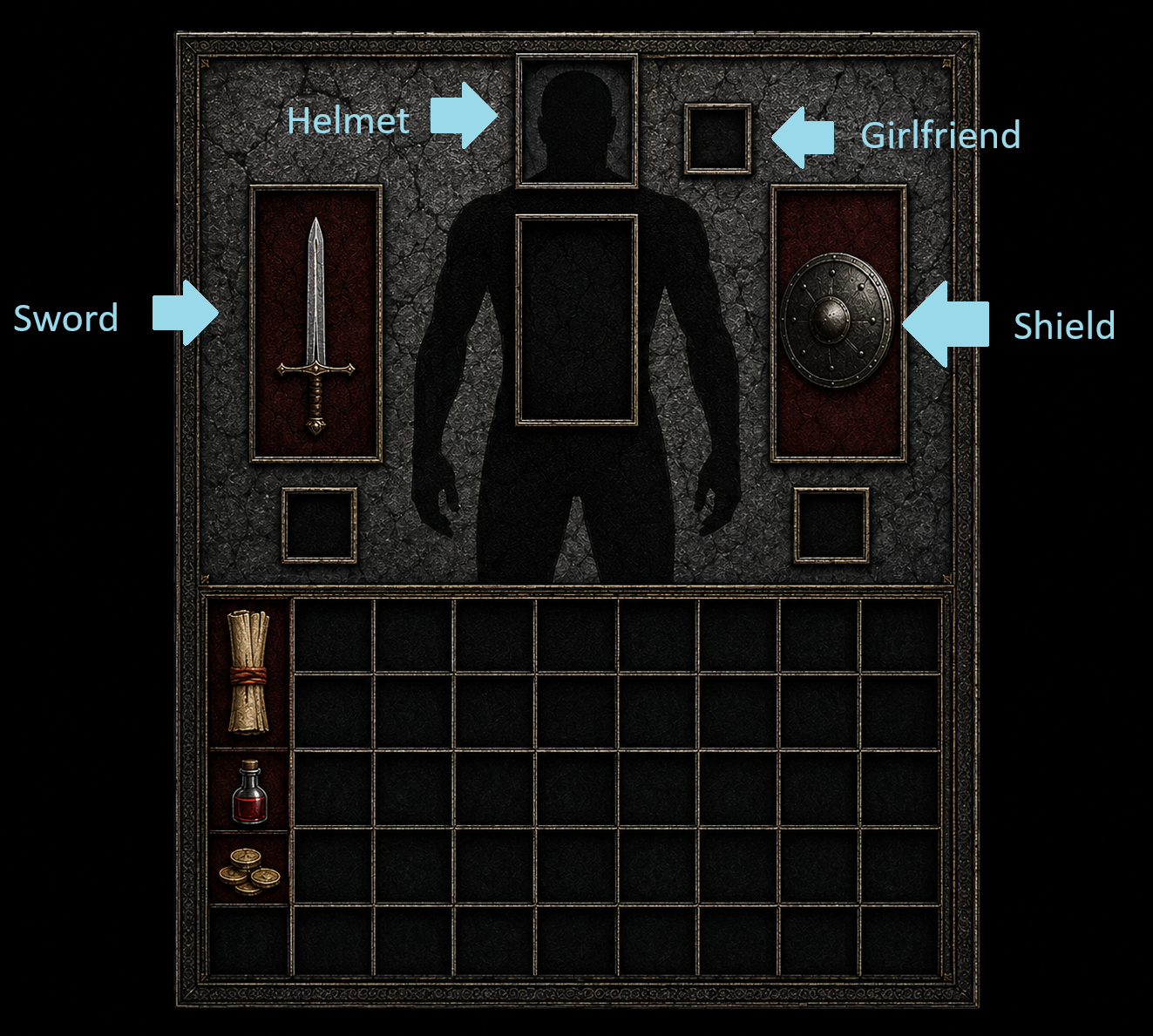
Image is AI slop.
🔗 Survival TLDR
Not finished yet.
🔗 Honesty
Honesty is not a property of individual sentences. It is a property of how we construct and transmit models of reality.
🔗 Honesty Is Much More Than Truthfulness
Outright lying is something which is near-universally socially condemned, and there are frequently a range of criminal offences associated with knowingly saying untrue things of material significance. Public figures know very well that lying – being untruthful – is nearly always a bad idea, or at least almost never a good one.
Honesty is about so much more than simply being truthful. This is a very large topic indeed: there are many, many ways in which a person can be dishonest without telling a lie. We do not have the slightest chance of covering a large chunk of them, but here are some of the examples I've seen repeatedly.
Dishonesty is often a process of emotional load-shifting rather than inventing or obscuring facts. Understanding the context and framing is critical before describing a claim as dishonest.
🔗 Context Matters
We'll be discussing some examples of processes by which someone can be dishonest. The fact that someone has done any of this is not inherent evidence of dishonesty on its own – there are honest ways to use most of this.
What is the affirmation that a witness must make before giving evidence in court? That they will tell the truth, the whole truth, and nothing but the truth, right?
🔗 Avoidance
This is a violation of telling the truth.
We can avoid having to tell (or not tell) the truth at all, simply by avoiding discussing it entirely. This is the cleanest and easiest-to-excuse form of dishonesty, because by saying nothing at all you are providing the minimum amount of ammunition possible.
Because people are so used to getting away with this one, it is often not thought of as dishonesty. But dishonesty it certainly can be, and its greater effectiveness means the consequences of it on others are often even greater than more explicit forms.
🔗 I Don't Recall
There is an extremely common and socially significant type of avoidance that we've all seen before: professing not to remember. This is usually safe, even in a court of law, because nobody can actually prove what you do or don't remember on a given day (unless you explicitly admit to lying later).
🔗 Omission
This is a violation of telling the whole truth. It's another very familiar one: selectively leaving out parts of the facts to benefit the narrative you want to sell.
🔗 Two Truths And A Lie
This is a violation of telling nothing but the truth.
If we present someone with a series of high-consequence truths they weren't aware of, slipping in a lie or two often becomes really trivial. Those truths do not become untruths, but they were presented dishonestly: as a bona fide for a lie.
When someone sees a series of shocking, dramatic new true information, and plenty of evidence for it, the momentum of belief can carry all kinds of things over the line smoothly.
🔗 Mirroring
Implying a false equivalency by repeating language or concepts back at the person.
🔗 Side Channel Attacks
This is a piece of terminology from information security. A "side channel attack" is one which doesn't take the system head-on, but instead attacks it in some circumstantial way - for example, watching someone type in their password.
When the concept is used in interpersonal dishonesty, it generally manifests as avoiding addressing the what by attacking the how, when, who and why.
This approach is often adjacent to ad-hominem attacks - rather than taking an argument head-on, you find some trait of the person to criticise in an attempt to broadly discredit them.
🔗 Conclusions Without Construction
Todo: I tell you the answer as a fact but without the context or any information which led me to it, which dishonestly puts me in a position of power when discussing it
This is often interlocked with declaring that asking for an explanation is proof of the conclusion.
🔗 Looks Like/Sounds Like/Feels Like
When an appearance is taken as the truth in itself – the presence of a different underlying reality is shuffled to the side.
Real world example:
"It looks like X."
"Sure, but we both know that isn't right."
"Yes, but it looks like X."
🔗 Deliberate Mishearing
This generally involves actually lying, but in a deniable format.
"What's that?"
"Oh, a ginger beer."
"You're not allowed alcohol here."
"It isn't alcoholic."
"I know you think it's just a beer, but you still shouldn't have it here."
"No, like Bundaberg. GINGER beer."
"Pour it out."
🔗 Selective Deafness
🔗 You Would Say This
Having a go at someone for something you think they'd say, even when they've said nothing.
🔗 Tactical Approximation
When we take a knowingly-wrong "close-enough" interpretation of what was said, and usually use that as a bridge for further "close-enough" associations to get to the conclusion we want to be true.
Here's a theoretical example based on the very essay you're reading:
Wrote about honesty ≈ thinks everyone should always be 100% honest all the time ≈ any situation where someone felt misled by them must be hypocrisy.
These cases often revolve around a pre-built narrative that the person wants the facts to fit.
🔗 Sentiment Blindness
Total inability to reflect honestly because of how we feel about the person speaking.
🔗 Emotional Veto/Trauma Evocation
Todo
- Using emotion or trauma as evidence or as a trump card to avoid reflection and/or accountability
🔗 Tactical Empathy Withdrawal
Todo
- Withdrawing empathy or curiosity only when it would require self-reflection
🔗 Event Shielding
When there's a specific, real, serious event which has actually happened, and you use it as a blanket excuse for things which weren't actually impacted.
🔗 Deliberate Obtuseness
Todo
🔗 Scope Collapse
You write about X, Y, and Z. The interplay of these three things combined is really important.
I come along and read it.
I don't really know much about X or particularly care about it, and I actually don't even know what the term Y refers to. But I know all about Z, so I am going to attack anything you say about Z based on my understanding of Z alone.
I speak honestly about what I think of Z, but the scope is not Z. It's about X, Y and Z all together.
The person responds to the thing they understand, but miss the scope of what is actually being talked about. By responding to the topic authoritatively, they are being dishonest about their understanding of it.
🔗 Fill In The Gaps With What We Want To Hear
Todo
🔗 Didn't Actually Read It
These are often some of the most comical examples of dishonesty, and the person will nearly always say they "skimmed" it.
Generally if you disagree with something, it's worth knowing what you disagree with.
🔗 The AI Summary Missed The Point
Todo
🔗 Opinions Based On Insecurities
Todo
🔗 Weaponising Unknown Information
eg yelling at you for doing something completely reasonable with the information you had
🔗 Covering With Anger
Todo
🔗 Random Assumptions
Todo
🔗 It's The Vibe
Todo - no specific reason for saying it, it's just how you feel about it
🔗 Emotional Inertia
Saw one thing that upset you, and characterised everything else based on that emotional reaction.
🔗 Emotions As Evidence
"I feel abused, therefore I was abused"
🔗 Self-Honesty
All of the above is not limited to our interactions with others. These emotional sleights of hand happen in our inner dialogue too, allowing us to delude ourselves into believing comfortable narratives we know are wrong. I would even argue that most people (ie non-psychopaths) have to go through this process first before they can present their deception to others. For this reason, it is problematic to say that intent is a necessary factor in being deceptive.
Honesty, or the lack thereof, is a dialectical process.
🔗 Honesty Without Truthfulness
There are a pretty wide range of situations in which a person can be honest but not truthful, and almost all of them are a result of the person having incomplete information (or memories).
Amnesia is actually super common, and the brain defaults to filling in gaps
🔗 Fuzzing
Fuzzing is a technique used to protect a person's sincerity towards one person by sacrificing their honesty towards another.
It relocates the harm of dishonesty from one person to another – which allows the person to be emotionally aligned with someone other than the person they're speaking to. Sincerity towards that someone is preserved, but at a cost to someone who may not be a party to the other relationship.
Because this is (at minimum) a three-way exchange, it is easy to justify from the fact that you're doing right by the person that matters to you. But it is still dishonesty to the other party.
🔗 Malicious False Honesty
We've all heard "no offense, but-" as a way to maximise damage. Most people know that this phrase means "I'm about to say something offensive and I want to maximise pain but be held immune from consequences."
This most commonly takes the form of straight-up attacking someone then justifying the statements by saying they're "just being honest". This is also emotional abuse: it is gratuitously rubbing salt into wounds by using statements that are engineered to harm, then citing them as "facts" – the statement about the words being honest is a deliberate effort to increase the harm.
🔗 Malicious True Honesty
This pattern is an example of honesty without sincerity.
The statements shared are true and complete, but made in the full knowledge that it will harm the recipient – and with a disregard for the results of doing so. People who do this typically hide behind the truth of the statement(s) and not the foreseeable consequences they have.
The flipside of this is withholding information from someone because you don't think they have the capacity to hear it, which can easily turn into a power play or dominance game. This topic is nuanced and requires careful judgement.
🔗 Honesty Has A Cost
The cost of honesty is rarely paid by the people who benefited from the lie.
Not finished yet.
🔗 That Cost Is Often Returned With Interest
Not finished yet.
🔗 Skills
Todo
🔗 Reminder
Todo
🔗 Controlling Behaviours
Not finished yet.
🔗 A Razor
Hypothesis: The median person will generally default to the explanation of conflict which costs them the least social resources, unless they have prior experience with manipulation.
Not finished yet.
🔗 Transactional vs Reciprocal Relationships
Operators consistently seem to have a transactional relational style.
Not finished yet.
🔗 Drama Laundering
Not finished yet.
🔗 Narrative Enclosure
This is how they keep getting away with it.
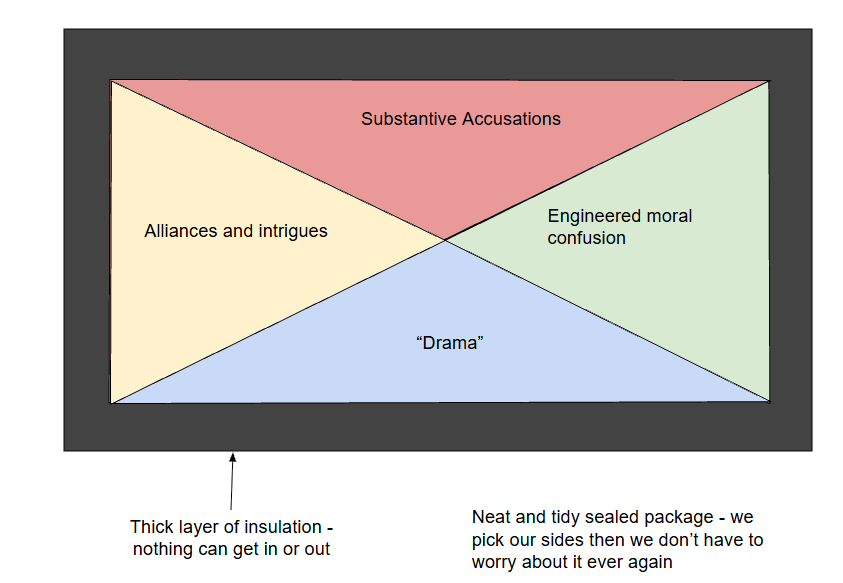
If we strictly seal ourselves off from new information, we don't need to do an update later, and we never reach a position where we can (or have to) actually learn from what happened.
Not finished yet.
🔗 Documentary Substitution
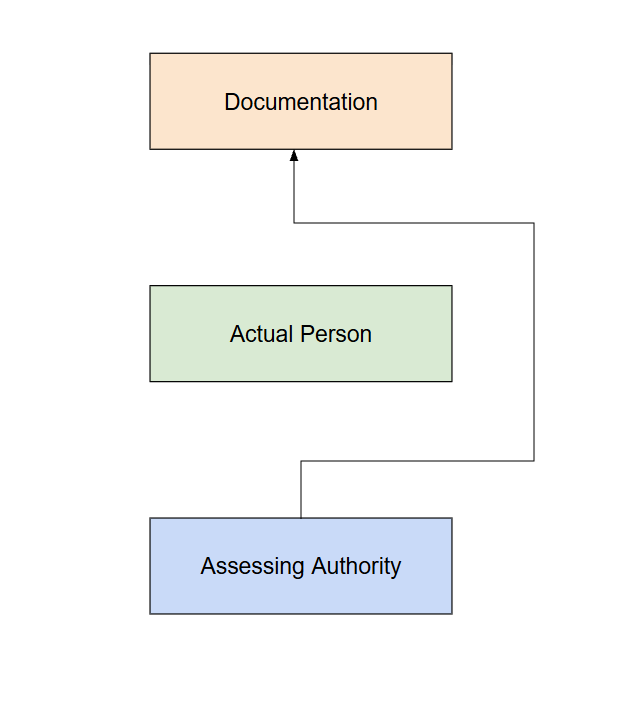
Not finished yet.
🔗 Fatigue Manipulation
Not finished yet.
🔗 Policing
What police fundamentally do is collapse a situation into good guy/bad guy without access to the context needed to actually understand who is acting in good faith.
In the criminal legal system, the courts are, at most, deciding whether or not to tick the checkbox of whether the police-originated case passes certain bars.
Not finished yet.
🔗 Legal Violence
Not finished yet.
🔗 Combination Attacks
It can actually get darker than legal violence.
- Combining different forms of coercion together
- Using one form to gain control in a second domain
Not finished yet.
🔗 Narratives Are Upstream Of Violence
Not finished yet.
🔗 The Heart Of Domestic Violence
One of the most common experiences of DV survivors is that the abuser "turned their friends against them." Visibility into the mechanics of this process is difficult, but they closely map to the mechanics we've been talking about here.
It is not hard to imagine a world where the social coercion we're talking about is the core element that makes domestic violence possible, while the actual physical violence is no more than the sharp edge of it, providing the ultimate enforcement mechanism.
If you ever wondered why the friends and family didn't say or do anything about the abuse: consider that the real question is actually "how did the surrounding social network become incapable of recognising or responding to the abuse?"
Not finished yet.
🔗 Psychopathy
Not finished yet.
🔗 Moral Courage
Anyone who consistently does the right thing (even when it costs them) will end up with a complex and mixed reputation (as a result of repeatedly paying that cost).
Not finished yet.
🔗 The Poor Man's Sociopath
Not finished yet.
🔗 When Manipulation Works, It's Invisible
By definition, anyone who has been manipulated does not think they've been manipulated. Successful manipulation is usually experienced as the person's own judgement: all they remember (looking back) is the negative impression of the target.
Not finished yet.
🔗 Privilege
Not finished yet.
🔗 Horizons
Our actions are a write-only ledger.
Manipulations may work in a certain group, for a certain amount of time, but our lives are long and intermingled.
Keeping the lie alive costs resources endlessly, and as networks overlap across time, the opportunities for it to fall apart only grow.
Not finished yet.
🔗 Boundary Enforcement
Ejecting threats from a social group before they can manifest.
Not finished yet.
🔗 Control and Connections
From the perspective of a person who is often oriented towards who is positioned around who, someone who uses these coercive tactics to isolate people who are a threat to them, being paranoid and controlling about the people they value (and who they're connected to) is entirely congruent.
Not finished yet.
🔗 Traumatic Growth
Not finished yet.
🔗 Shouting
Not finished yet.
🔗 Discomfort
Unfortunately, these dynamics sometimes apply to groups defined by social justice too.
Not finished yet.
🔗 Gagged
One of the most common tactics I've seen is to ensure that the person is unable to speak while the thing is happening, then shut down any later attempt to address it with "why are you obsessed with the past?"
Not finished yet.
🔗 The Large In The Small
People very quickly identifying someone as a "creep" etc - the tells that someone engages a coercive playbook ("danger signals") are sometimes visible in small interactions. This is fundamentally a test of socialisation.
This is one of the strongly gendered topics.
Not finished yet.
🔗 The Economy of Secrets
Not finished yet.
🔗 Isolation Trauma
Not finished yet.
🔗 The Sound of Silence
Not finished yet.
🔗 Encircling
Not finished yet.
🔗 Paperwork Precedence
Not finished yet.
🔗 Dangerous Nothing
Not finished yet.
🔗 "Drama" Is Just Peoples' Lives
Not finished yet.
🔗 Corollaries
Not finished yet.
🔗 Context and Patterns
This form of abuse is made out of ordinary social actions. Spotting some is not a DARVO "gotcha": it's the deliberate creation of an overarching pattern that makes it abuse.
Not finished yet.
🔗 Some thoughts
Some actual monsters are hiding in plain sight, and a large number of people are just going "meh" about it. They cause enormous, repeated harm through covert coercive behaviour, and most bystanders either don’t recognise it or choose not to intervene.
Hopefully this handbook will make it easier to see if you want to. And hopefully it'll help the reader spot the people who go "meh, not my problem" and respond accordingly. Increasing visibility of this crap will help change the cost equation ahead of time: making abuse or complicity have a material cost is something which can structurally shift the field.
If you choose to keep going "meh", the common justifications are now very openly visible.
If this framework becomes widely known, coverage of it is likely to become a microcosm of the topic. That fact warrants thinking about.
Special thanks to the half-dozen-or-so operators who showed me their playbooks up close in detail. You made this possible.